
idols
Beyond Knowledge
By Linda Rex
January 28, 2024, 4th Sunday | Epiphany—One of the things I had to learn early on as a fledgling pastor was the difference between head knowledge and heart knowledge. What I mean is, when speaking to the congregation, my purpose was not to inform them about a topic so much as it was to inspire them to follow Christ with greater depth and faithfulness. Fresh from my seminary classes, I was bubbling over with a lot of great information, but what was needed was not simply more theological information, but the living Word of God speaking a word through me that would touch the heart, that the Spirit could use to convict and transform the inner being of those who were listening.
In my family, as we grew up, one of the values that was important was knowing things or being well-informed on about every subject. This may be why I’ve always been fascinated by the newest discoveries in science, especially since reading Thomas F. Torrance’s books on the interrelation between science and theology. Science and theology, I once heard Dr. McKenna say, are intended to inform one another, to work together in unity for the betterment of humankind. Often, sad to say, this is not what happens.
Today, our scientific knowledge is constantly reaching new heights. I’m inevitably amazed by the new things we are finding out about our cosmos. Lately my interest has been in quantum theory—of which I know very little, but from what I can see, seems to echo the divine three-in-oneness of the Trinity. All this new science is fascinating and challenging, but from what I have seen historically, every advancement in science needs to be tempered by other-centered, self-giving love, or it presents the possibility for destruction and catastrophe.
This brings me to the passage for this Sunday, 1 Corinthians 8:1–13, in which the apostle Paul addresses some questions regarding whether believers should eat food offered to idols. Even though some believers knew and understood that idols had no real life in themselves, and meat offered to idols really was just, in the end, meat that could be eaten, there were believers who had, for many years, sacrificed meat to idols. Even though they had abandoned paganism and its practices when they came to faith in Christ, their conscience and understanding were not yet at the place where eating meat offered to idols was clearly okay. They still had questions and concerns, and were vulnerable to falling back into their old belief systems and practices.
So, the apostle Paul reminded believers that more important than the believers’ knowledge about meat offered to idols was their love and concern for their brothers and sisters. In other words, love trumps knowledge. Being knowledgeable can become a source of pride to us, and when we are not careful with it and insist on being able to do what we have a right to do or the freedom to do, we can severely injure others. Instead of trying to prove how knowledgeable we are or how free we are, Paul writes, we need to being concerned for the welfare of others, and do our best not to cause unnecessary harm.
Looking back over my brief years as a pastor, I see times when I was more interested in proving how much I knew and how right I was than I was concerned for the wellbeing of those I was ministering to. I was caught up in expressing my freedom in Christ—which is a good thing—but it was not always beneficial to those around me. If there are any who were wounded by this, I sincerely ask forgiveness, for I realize now that what I was doing was not always for the wellbeing of others.
Recently on Our Life in the Trinity, I talked about our sacred oneness, and my focus was on our human body, and the covenant relationship we have with God, and with our spouse. Our sacred oneness also involves our participation in the Body of Christ, the Church, for we are bound together by the Spirit to be of one mind and heart, for the sake of others. As brothers and sisters in Christ, united to God and one another by the Spirit, we are meant to live together, serve others, and testify to the love and grace of God in Christ, in sacred oneness.
Whatever the cost to ourselves today in caring for one another within and without the Body of Christ, it is nothing compared with the self-offering of our Lord Jesus Christ, who died for us that we may live. When any one of us insists upon our rights at the expense of others, or expressing our freedom in Christ in spite of its affect on others, we violate the sacred oneness of the Body of Christ. In fact, we violate Christ himself. We’re all on this journey together, growing up in Christ, but some of us are at different places along the journey. Rather than hindering one another’s progress, we want to be careful to edify or build up one another instead. Because, when all is said and done, what will last on into eternity won’t be “knowledge”, but other-centered, self-giving, serving love (1 Cor. 13).
Heavenly Father, you are the one from whom are all things and for whom we exist. Lord Jesus, you are the one by whom are all things and through whom we exist. Grant us the grace to always be careful not to injure or wound the conscience of others by our freedom in Christ. Fill us, by your Spirit, with other-centered self-giving love, and let it ever flow through us to others for their well-being, through Jesus our Lord. Amen.
“Now concerning things sacrificed to idols, we know that we all have knowledge. Knowledge makes arrogant, but love edifies. If anyone supposes that he knows anything, he has not yet known as he ought to know; but if anyone loves God, he is known by Him. Therefore concerning the eating of things sacrificed to idols, we know that there is no such thing as an idol in the world, and that there is no God but one. For even if there are so-called gods whether in heaven or on earth, as indeed there are many gods and many lords, yet for us there is but one God, the Father, from whom are all things and we exist for Him; and one Lord, Jesus Christ, by whom are all things, and we exist through Him. However not all men have this knowledge; but some, being accustomed to the idol until now, eat food as if it were sacrificed to an idol; and their conscience being weak is defiled. But food will not commend us to God; we are neither the worse if we do not eat, nor the better if we do eat. But take care that this liberty of yours does not somehow become a stumbling block to the weak. For if someone sees you, who have knowledge, dining in an idol’s temple, will not his conscience, if he is weak, be strengthened to eat things sacrificed to idols? For through your knowledge he who is weak is ruined, the brother for whose sake Christ died. And so, by sinning against the brethren and wounding their conscience when it is weak, you sin against Christ. Therefore, if food causes my brother to stumble, I will never eat meat again, so that I will not cause my brother to stumble.” 1 Corinthians 8:1–13 NASB
[Printable copy: https://lifeinthetrinity.blog/wp-content/uploads/2024/01/olitbeyond-knowledge.pdf ]
[More devotionals may be found at https://lifeinthetrinity.blog ]
[Subscribe to Our Life in the Trinity YouTube channel at https://www.youtube.com/@ourlifeinthetrinity ]
A Vacuum of the Soul
by Linda Rex
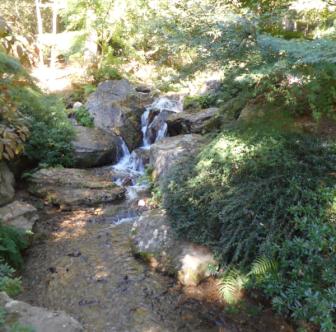
I was reading “Crossroads” by Wm. Paul Young this week and was caught by the picture of a desolate valley with a dry riverbed running through a broken-down temple. This empty place was meant to be filled with running water, which would have given life to all the plants and animals that lived there. This picture of a broken, desolate human soul was profound.
It took me back to the beginning in the book of Genesis where we see that God placed a garden, the Garden of Eden, at the headwaters of four major rivers. This river was a source of life to the garden and to all the areas around the garden. When Adam and Eve chose to decide for themselves what is good and evil rather than trusting God and eating of the tree of life, they found themselves no longer able to access this river of living water in the same way.
And humanity has been seeking to fill this vacuum in our souls ever since. We find so many ways to try to inject some life into our souls. We seek life through relationships, sexuality, wealth, fame, and a myriad of other fruitless efforts. Instead of freedom and life we often find ourselves even more empty and enslaved to demanding taskmasters such as addictions, obsessions, depression and despair.
The prophet Ezekiel predicted one day a temple would be built from which a river of water would flow—one that was so strong and so wide that it could not be crossed. This river of water would flow out and bring healing and restoration to the salted desolate places.
It is instructive that the final picture we have of the summation of all things in the book of Revelation is a picture of God and the Lamb Jesus Christ being the temple from which flows the river of life. God has made his dwelling place with us as human beings and will never leave. His life, the Holy Spirit, forever proceeds from God’s inner being through Christ to all people.
Jesus, when he came, said that he would give the gift of a fountain of living water within our souls for those who are spiritually thirsty. He said this living water would overflow to others around us, so that they would also find their thirst quenched as well. Our souls were meant to be a place filled with the rushing water of the Holy Spirit, flowing in, through and from us, bringing life and renewal.
In the Epistles, we find that our bodies are temples where the Holy Spirit dwells. God with us. We were never meant to live with the emptiness and loneliness of going through life on our own without God. We were created to be filled with and overflowing with God’s real presence through Jesus and in the Spirit. For this is true life, real life—knowing God and Jesus whom he sent. It is living in relationship each moment with the God who made us and loves us, and will not be God without us.
It can be quite fearful and challenging to stop and take a look inside. What things are we clinging to? What have we made monuments to in our hearts and souls, such that there is no room for anything or anyone else? What has taken the place that was meant for God and God alone? For this is what is creating that vacuum—that hunger that will never be satisfied. Here is where we must, like Abraham, Isaac and Jacob, cast out all our idols and make room for God. What must we release our hold on so that we can wrap our fingers around the hand which holds us so tenderly and tightly? May God give us the grace to let go.
Dear Holy God, thank you for your gift of Living Water. We long to be nourished by your Holy Spirit, to be renewed and refreshed, healed and restored. Lord, today we release our control over our lives and let go of those things we cling to in your place. Forgive us for placing our trust in things and people other than you and for depending on ourselves instead of you. Wash these all away in the River of your love. In Jesus’ name and by your Spirit. Amen.
“Now a river flowed out of Eden to water the garden; and from there it divided and became four rivers.” Genesis 2:10 NASB
“Then he brought me back to the door of the house; and behold, water was flowing from under the threshold of the house toward the east, for the house faced east. And the water was flowing down from under, from the right side of the house, from south of the altar….Again he measured a thousand; and it was a river that I could not ford, for the water had risen, enough water to swim in, a river that could not be forded.” Ezekiel 47:1, 5 NASB
“Jesus answered and said to her, “Everyone who drinks of this water will thirst again; but whoever drinks of the water that I will give him shall never thirst; but the water that I will give him will become in him a well of water springing up to eternal life.” John 4:13–14 NASB
“Now on the last day, the great day of the feast, Jesus stood and cried out, saying, “If anyone is thirsty, let him come to Me and drink. He who believes in Me, as the Scripture said, ‘From his innermost being will flow rivers of living water.’ ” John 7:37–38 NASB
“Then he showed me a river of the water of life, clear as crystal, coming from the throne of God and of the Lamb, in the middle of its street. On either side of the river was the tree of life, bearing twelve kinds of fruit, yielding its fruit every month; and the leaves of the tree were for the healing of the nations. Revelation 22:1–2 NASB
 Our Life in the Trinity