
Holy Spirit
What Did You Get for Christmas?

by Linda Rex
I was mulling over the Christmas tradition of gift giving and a question came to my mind as to the difference between getting a gift and receiving a gift. Are these two acts the same? Are these expressions synonymous?
It seems that the whole Santa tradition here in America has become more and more a commercial enterprise rather than the fairy tale it started out as. When I hear people talk about Christmas for their kids I hear a lot of anxiety about being able to get the presents their children want and whether or not they will be in hock for months on end because of what they spent on those presents. Some people who are not financially savvy will spend their rent money or bill money on presents for their kids just because they want them to have Christmas (Nevermind that their electricity is turned off for the next three months of winter!).
As a child sits on the mall Santa’s knees the jolly fellow in red and white will ask him or her what the child wants for Christmas. If the child is not too shy, he will receive a litany of hopeful expectations of presents. Whether or not the child will receive those presents, unfortunately (Santa unbeliever that I am) will depend pretty much on the parents’ budget and the thoughtfulness of grandparents and others. The child really doesn’t have a whole lot of control over what is going to show up in his stocking or under the Christmas tree.
Sometimes I think the whole process would be a lot healthier and happier if children and adults alike not only understood the nativity and the gift of the Christ child, but also understood that there is a difference between getting what we want and receiving what is given.
In getting what we want, we are an essential part of the process. We get to decide what we want. We get to decide what’s important to us and what matters most to us. We get to make a list of all the things we think are essential to our life and happiness.
In receiving, we really are not a part of the process at all except in that we reach out and receive what is given. We don’t really have a say in what we receive—we just receive it and make it ours. It becomes essential to us when we receive it in gratitude and put it to use.
In M. Craig Barnes book “Sacred Thirst”, the author tells about the Asian custom of gift giving and receiving that is always done with two hands. He explains that there is a moment in this act of giving when both the giver and the receiver share the gift. He draws upon this image as he reminds us of “the two hands of God”, the incarnate Jesus Christ and the Holy Spirit. In giving us Jesus and the Holy Spirit, God gives us himself. All we are asked to do is to receive with open hands the gift that was and is given.
To receive God through Jesus and in the Spirit means that we need to come with empty hands. We need to shred our Christmas wish list of expectations and receive what God has given with humble thankfulness for God’s grace and generosity. We need to give up our insistence that what’s in the stocking and under the tree is what we think we need to have for our life and happiness. We need to stop eating from the tree of good and evil and start eating from the tree of life.
This is another reason it is a good idea to teach children the story of the coming of God in human flesh in the person of baby Jesus. Santa can also be a fun story to tell, but personally I chose instead to tell the story of Kris Kringle who was generous in heart and gave to the poor children who had nothing and were grateful to receive whatever he gave.
This is a picture of you and me, the spiritually poor and needy, longing to have the deep needs of our heart and soul, as well as our body, fulfilled. We come to God with open hands and hungry souls and he generously gives us all we need for life and godliness.
It also teaches us to reach out to others with all God has given us and to freely fill their empty hands with his love and grace, and whatever other needs we may see. When we toss aside all our preconceptions of what God is doing and will do, and receive full what he is offering—himself in Christ through the Spirit in intimate relationship, moment by moment—we will never be the same. Because we will be living out Christmas all year round.
God has given us himself in Jesus Christ in his life, death, resurrection and ascension, and continues even now to pour himself out to us in the Holy Spirit. We can live as though none of this is true and continue to work to get the things we want and think we need all on our own—trying to fill the thirst of our soul in our own way. Or we can let go of all our expectations and receive the gift God has given—new life in Christ through the Spirit.
May your New Year be full of God’s love, truth and grace!
Thank you, Father, for the beautiful and generous gift you have given us of yourself in Jesus Christ and in the Holy Spirit. Grant us the grace to let go of all the expectations and desires that consume our attention and to receive with open, empty hands your perfect gift. Throughout this new year and into the future, pour into us your new life, hope, joy, and peace. You are all we need. Amen.
“After coming into the house they saw the Child with Mary His mother; and they fell to the ground and worshiped Him. Then, opening their treasures, they presented to Him gifts of gold, frankincense, and myrrh.” Matthew 2:11 NASB
More Than Just a Law

by Linda Rex
A while ago I wrote a blog “The Curses and the Ten Commandments” in which I talked about our assumptions regarding the nature of God and the curses and law he gave to Israel. I believe God’s intent was to call his people to a deeper way of thinking and believing that involved a relationship of covenant love with him and with one another rather than to just obey a list of do’s and don’t’s.
In my daily readings I’m in the book of Joshua now, and in chapter 8 I came across the circumstance where Joshua and the nation of Israel actually put into effect what Moses instructed them to do at Mount Ebal and Mount Gerizim. It is interesting that it says that they did it “just as Moses the servant of the Lord had given command at first to bless the people of Israel.” (v. 33) God’s intent from the beginning was to bless Israel, not to curse them. His heart toward them was love.
Here at this place the entire law was read to the people of Israel and the strangers who were among them. The law of Moses was also written on stone at this place. Was this just the Ten Commandments, or was it a summary of all the laws we find in the Torah? I guess I would need to look back into the traditions of the nation to find out the answer to that question.
But the point here is that after the long journey in the wilderness in which the older generation passed away and the new generation came across the Jordan into the Promised Land, Israel renewed their covenant relationship with God. They heard what it looks like to live in a loving relationship with God and with one another. They were told what would happen if they chose to live out of sync with who they were as God’s covenant people. The new generation was called to love God and love one another as they entered into their new life in their new land.
It is instructive that this event occurred after what happened at Ai. After Israel had crossed the Jordan River, God had toppled the walls of Jericho, allowing the Israelites to completely demolish the city. The Israelites were on such a high from their success that they took off to Ai and attacked that city as well. But there was a small problem—they didn’t ask God first. And so they were routed at their first attempt and suffered a humiliating defeat.
What they didn’t realize was that somewhere in the midst of their nation was a person who had violated the covenant relationship. This person had insulted the God who was the nation’s Warrior by taking things from Jericho which had been devoted to God, and hiding them among his personal belongings. Achan had stolen from God. Sure, it was a little thing, but God is in the little things as well as the big things. All of life is open to and revealed to the God who lives not only in heaven but who also is omnipresent—around, in and with us moment by moment.
After this issue was resolved, then God gave the nation instructions on how to attack the city of Ai. And it was defeated, just as he told them it would be. God knew that if the Israelites took on the people of Canaan on their own, they would be destroyed. But in relationship with him, no one could defeat them. He was committed to their success, not their failure. But only as they participated in his plan for their lives. Only as they lived in loving relationship with him.
It seems pretty gruesome to us today to think that God would instruct one nation to destroy another nation. But he had his reasons and that’s food for an entirely different discussion. Israel had a reason for her existence—to be the womb of the Messiah, and there were things that had to be done to prepare the way for the events of that sacred Bethlehem night when Jesus was born. All these people who lived and died were taken up in the life, death, and resurrection of Jesus our Messiah—so God made it all right in the end.
The key thought here is though, God doesn’t exist in a vacuum somewhere out in space or up in heaven, isolated from us as human beings. True, he is transcendent—completely other than we are, and we only know his immanence or nearness as he chooses to reveal himself to us. But he also chooses to be in relationship with us as human beings. He chooses to relate to us one on one. And he proved this by coming and existing in our humanity as the man Jesus Christ.
We are often so busy living our lives, doing what we do to survive, that we don’t stop and sit in the stillness with God. We don’t sense God in the quiet and in the active moments of our lives where he is truly present all the time. We, who were created to live in relationship with God and were given that relationship freely through the incarnation of Jesus Christ, live as though God doesn’t exist. But he does—and we would know it, if we would just make room for him in our hearts and lives.
So, perhaps, like the Israelites, we need to take the time to sit and listen to the words of love God has for us in his Word and by his Spirit. Perhaps we need to climb up on our divine Daddy’s knees and nestle against his chest and feel his divine Breath against our cheek.
Maybe we need to sense his presence with us as we mow the lawn and close that business deal. Just possibly, we might realize he’s smiling too as we see our child score the winning goal for the soccer team. For he loves each and every one of us and he waits with open arms to embrace us and hold us close anytime we choose to run to him. Maybe even now would be a good time to begin this new way of living life—in close companionship with the One who loves us with a never ending love.
Our heavenly Dad, who not only lives in eternity but is also present in us, with us and for us at each moment, thank you for your great unfailing love. Remind each of us today how much you love us. Show us that we are precious in your sight. Teach us how to create room for you in our lives and hearts. We want to participate in all that you are doing—to share life with you now and forever through Jesus Christ and in the Spirit. Amen.
“He wrote there on the stones a copy of the law of Moses, which he had written, in the presence of the sons of Israel. All Israel with their elders and officers and their judges were standing on both sides of the ark before the Levitical priests who carried the ark of the covenant of the LORD, the stranger as well as the native. Half of them stood in front of Mount Gerizim and half of them in front of Mount Ebal, just as Moses the servant of the LORD had given command at first to bless the people of Israel.” Joshua 8:32-33 NASB
The Kingdom, the Baker and Breadmaking
by Linda Rex
Jesus had this way of taking the most everyday tasks and events and turning them into a deeply spiritual concept, especially when he started talking about the kingdom of God. One of those unique parables of Jesus was brought to my attention in a new way this week as I prepared for Sunday’s sermon.
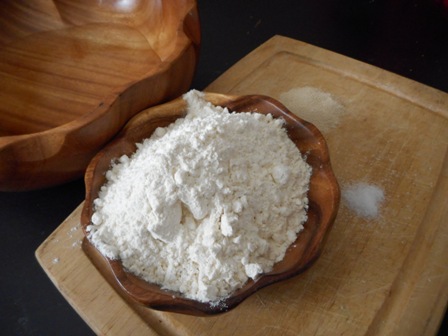
Previously, I hadn’t given much focused thought on the idea that Jesus described God as a baker. And not just a baker, but a woman who baked bread. And she wasn’t a wimpy woman at that—she was able to handle a large amount of dough at once. Three pecks of flour is the equivalent of 16 five-pound bags—enough with about 42 cups of water to make about 101 pounds of dough. That’s a lot of dough!(1)
So, here I see pictured a woman who is doing an everyday task—making bread, and she is physically strong and capable. I like that. How often we women are called on to be physically strong and capable!
I think sometimes that we assume that the Bible and Jesus portray God as being male since most of the language used in relation to him is masculine. But there is a significant difference between human gender and the gender of human language. We have to keep that in mind when we begin to think seriously about the nature of God.
I know that many men are good bakers. In fact, I remember my dad being fond of making unleavened bread. It was something he took up doing late in life that I never expected to find him doing. I tasted some of his products and they were pretty good. But perhaps the culture in Jesus’ day expected a baker to be female—so here God is pictured as a woman.
Breadmaking is something I enjoy doing. In fact, at one point in my life, I started making all our bread by hand because the motion of kneading the dough helped me to heal from an injury to my wrist. It became a therapy that prevented me from having to have surgery. And it worked. And it’s a creative process. I love being creative—I take after the Creator in that way.
But, back to the Breadmaker. The woman with all that flour hides leaven in the flour and it all becomes leavened. One of the simplest recipes I’ve used is for making pizza dough, and it probably resembles pretty closely how bread was made centuries ago. And it got me to thinking about how hiding leaven in flour is related to the kingdom of God.
Most all of the recipes that I can think of for bread start with yeast and water (or milk), a touch of salt and oil. All of that comes first. It is possible that what is meant by leaven in this parable was sourdough starter, which is a small batch of dough that is full of active yeast cultures. Either way, the ingredients that we start bread with—oil, salt, water—along with the yeast, are often used in the Word to describe God, Jesus and the Holy Spirit. This is worth giving meditative thought to.
In fact, I go back to the beginning of the world and find there hovering over the deep waters, the Spirit of God, who when the Word spoke the will of the Father, brought about our existence. God breathed the Breath of life into all that lives and breathes. All the animals and humans breathe oxygen in and carbon dioxide out. It is carbon dioxide that is created when the yeast in bread begins the fermentation process. And this is what causes the dough to rise. Thought-provoking.
Once these leavening ingredients are blended with the flour, there is no separating of them. The leavening process begins to fill the whole wad of dough, especially when the strong, capable baker begins to knead the dough. I’m not even sure she could stop the process once she started. The leaven is an intimate part of the dough, and this becomes evident as the dough begins to rise, and when it is baked into bread.
The kingdom of God is not something that just appeared when Jesus came to earth. For he was in the person of the Word, present in the beginning with the Father and the Spirit when all was made. The purposes and plans of God have not been derailed, but are gradually being kneaded into the dough. In time the heat of the fire will reveal an awesome loaf of bread.
In the meantime though, we find that the dough isn’t always compliant and responsive to the baker. As she pushes the dough down with her hands, the dough pushes back. The working of the dough and its response both positive and negative are a part of the bread-making process.
We tend to think God’s goal right now is to get rid of everything bad in the world. Just slay all these dragons, Lord! But the thing is that God is allowing the evil here for the moment—though he hates what it does to his children—so that he can accomplish the kingdom work he’s trying to do. He’s allowing us to resist him—though it’s foolish to do so—because he knows that it is a part of the free will and growing up process. He’s big enough, clever enough, perfect enough to deal with evil summarily and completely in his own time and way. But he doesn’t always do it right this minute when we think he should.
The baker decides what the end loaf is going to look like. Dough can be used for many things. In fact it can be divided up and used as individual little loafs we call dinner rolls. It can be used as a base for pizza. It can be broiled, boiled and baked as bagels. It can be fried as fritters or sweetened and spiced as cinnamon rolls. Or it can just be made into a plain, old loaf of bread. That’s the baker’s call.
We don’t know what the kingdom of God is going to look like in the end. We’re not really sure what the divine Baker is doing right now or why he is doing it. But one thing is sure—the leaven is filling the whole loaf. And all that God has created shares his Breath of life and participates in his kingdom life. And God’s not going to quit until he has a perfect loaf of bread. I can’t wait to see how it turns out and what it tastes like. I have a feeling it might taste a lot like the bread on Sunday morning’s communion plate.
Holy God, our Heavenly Baker, we are so thankful that you know what you are doing. We’re grateful that we can trust you to do everything necessary to complete the breadmaking process and to bring to pass the fullness of your kingdom. We trust you to finish what you have begun, and we look forward to sharing the bread of heaven with you in eternal communion. In the name of the Father, Son and Spirit. Amen.
”He spoke another parable to them, ‘The kingdom of heaven is like leaven, which a woman took and hid in three pecks of flour until it was all leavened.’” Matt 13:33 NASB
(1) Capon, Robert Farrar. Kingdom, Grace, Judgment: Paradox, Outrage, and Vindication in the Parables of Jesus. Grand Rapids, MI: William B. Eerdmans Publishing Company, 2002. Pg. 100.
Dying Embers
By Linda Rex
One of the things I enjoy doing on a summer night is to sit around an open fire with friends and family. Something about sharing laughter and stories under a starry sky is heartwarming and inspiring.
Eventually the fire burns down and there are only glowing coals left. During a pause in conversation, the night sounds become more pronounced. Out on the farm in Missouri and in Iowa, we would hear the coyotes, owls and frogs, along with the constant chirp of the crickets.
Any fire left unattended and unfed would eventually go out. But even a few dying embers, if fed the right fuel and given enough oxygen, would burst back into flames.
There are times when I feel as though my inner spiritual flame has been left unattended too long. Being preoccupied with daily living and worn down with the stresses of everyday life, even of ministry itself, can become spiritually suffocating. Even though I know God is near, sometimes I can feel as though the flame of faith within me has been reduced to dying embers.
If it was fully dependent upon me to keep the flame of faith alive, I would be in real trouble. It is a comfort to know that Jesus Christ stands ever ready to intercede and to fill each of us with his faith, with the fresh air of his Spirit of power, love and self-discipline. I am grateful that the Spirit does not come and go willy-nilly, but he abides—he stays. God is ever-present, fully in us, with us, for us.
Yes, we can and should participate in the ministry of the Spirit by inviting him to fill us. We can open ourselves to hear and heed his Word to us. We can be willing to suffer if necessary for the sake of Christ. And we can actively, in whatever way he gives us, bear witness to the grace of God for us in Jesus Christ. All of these things help to fan the flame of the Spirit within us.
Even if you feel like all that is left within you are just a few dying embers, do not give up hope. Perhaps all you need is a fresh wind of the Holy Spirit or a hefty chunk of his Word to feed the flame. Maybe just adding a twig or two of effort to share with someone the story of how God has done something special in your life will do the trick. Maybe just a sigh of a prayer, “God, I’m here and I’m yours” is what’s needed. Each and every one of these bits of fuel can help reignite the fire of faith.
And never forget the power of community—spiritual community feeds the fire of faith. This is why we’re encouraged not to neglect assembling together with others who believe in Christ. How often our faith is renewed by the prayer, the concern and/or a fitting word from someone who listened and who knew just what to say!
In any case, never give up hope. The fire may have died down. There may only be few glowing coals left. But even a few dying embers have the capacity to ignite a holy flame.
Holy God, please refresh us today, reigniting the fire of your Presence within. Restore and renew our faith. Bring us back to full flame, feeding us with the fuel of your Spirit, your Word and your testimony. We praise you for your faithfulness in keeping us alit with the fire of faith. We trust you will finish what you have begun in us by your Spirit, in Jesus’ name. Amen.
“I have been reminded of your sincere faith, which first lived in your grandmother Lois and in your mother Eunice and, I am persuaded, now lives in you also. For this reason I remind you to fan into flame the gift of God, which is in you through the laying on of my hands. For God did not give us a spirit of timidity, but a spirit of power, of love and of self-discipline. So do not be ashamed to testify about our Lord, or ashamed of me his prisoner. But join with me in suffering for the gospel, by the power of God, who has saved us and called us to a holy life—not because of anything we have done but because of his own purpose and grace.” 2 Timothy 1:5–9 NIV
- ← Previous
- 1
- …
- 33
- 34
 Our Life in the Trinity