
Month: February 2018
Signs of Spring
By Linda Rex
Preparation for Easter or Lent
For me, driving to the post office means taking a spin in my car through the Tennessee countryside. I get to see pretty ranches with horses and cattle, rocks and trees on the hills, and lovely homes in the valleys. I pass a pond where the ducks paddle about looking for tidbits to eat. Though right now most of the trees have no leaves and the ground is covered with brown leaves from last fall, there is still a quiet sense of beauty and the presence of God.
As I drove through the woods this morning, the road opened up to where I passed by a tall willow tree. Though the other night the tree was gray and seemed to be dripping sorrow, this morning it was covered with little green leaves. The difference was striking and quite beautiful.
On the ground nearby where grass was beginning to turn green again there were some yellow daffodils blooming their hearts out. The signs of spring were everywhere this morning. And I had to ask myself, as one who spent many a winter in southeast Iowa, what’s going to happen when it freezes again? It is only February—it’s too soon for all this!
In the story of Abraham and Sarah, we are reminded there are always signs of spring, even when the evidence tells us otherwise. God came to them when they were too old to have children, when their bodies were beyond the capacity for child-bearing, and told them Sarah would have a child. God presented them with a paradox of hope in which the only proper response would be faith—an implicit trust in the faithfulness and goodness of God.
We may find ourselves today in the winter of our lives where all our hope is dead and we don’t see any hope for new life. We may be stepping out into new ways of living and being, but all we are meeting with is opposition and resistance. And yet, it is good to be reminded these bleak and difficult times may be the very place where we experience the greatest new growth and transformation.
What we need in the midst of our winter or death and dying is hope. We need to see with the eyes of faith the evidence that spring is on its way. We need to recognize the reality that even when death is all around us, there is new life being birthed in that very moment.
During the season of Lent, we have the opportunity to reexamine the life of Christ at work within us and be reminded of how God has called us into relationship with himself in Jesus Christ. The Spirit enables us to see what is really going on in our hearts and minds, and in those areas we have turned away from Christ, he invites us to turn back again. At the basis of our examination, though, needs to be an assurance of God’s love and faithfulness to us as expressed in the gift of his Son and the pouring out of his Spirit.
We were created for life—life in close relationship with Abba and Jesus in the Spirit. The real life we were created for is a communion and oneness of being in which there is a mutual pouring out of and pouring into by each and every participant of God’s life. We make room for others as they make room for us. We make room for God as he has and does make room for us in Christ and by his Spirit.
It is the disruptions of this perichoretic life which we attend to during Lent. We may ask ourselves, “How am I participating in God’s life and love? Am I living in the truth of who I am as God’s child, made in his image? Does my life and how I live it orbit around myself, or am I keeping in step with the divine dance—receiving and giving—receiving what God pours into me and pouring it back out into God and others? In what ways should I turn away from myself and turn back to Christ and Abba, and out to those around me?”
The point of this contemplation is not to focus upon ourselves. If our examination of the life of Christ at work within us revolves around us and our failures, we have missed the point. This kind of self-examination only creates discouragement and defeat. It focuses on death and dying. And it does not attend to what really matters—the life of Christ at work within us by the Holy Spirit.
Our journey during Lent can echo Christ’s journey during his forty days in the wilderness. He was challenged by Satan to deny his identity as the Son of Man and to live out of his being as the Son of God. But Christ identified with you and me instead by choosing to live in total dependency upon his Abba by the Spirit.
This is our life. As Satan attempts to draw us away from this truth of our being, distracting us with all the ways we can live as gods and goddesses under our own steam, we can instead choose life. We can choose instead the eternal life Jesus spoke of which is the deep knowing of our Abba and the Son he sent. Instead of focusing on our failures and shortcomings, we focus on the reality Jesus stood in our place—his life for our life. We share in his perfect relationship with his Abba by the Spirit.
Instead of relying upon ourselves in self-centered living, we can live in total dependency upon Abba through Jesus in the Spirit. Satan and his ways of self-centered living are defeated foes. Death, evil, and sin may still be all around us, and still haunt the inner recesses of our mind and heart, but the true reality of our perfected humanity is hidden with Christ in God. There is life in the midst of death—hope in the midst of failure, sorrow, and defeat.
We need to attend to the signs of spring and ignore the overwhelming evidence of winter all around us. We need to walk by faith, not by sight. Christ is our life, and he lives within us by his Spirit. God is at work even now, and will not cease working to make all things new—in heaven, and on earth, and within us. And he will finish what he has begun—we have his word on this—and, thankfully, God always keeps his word. He is trustworthy.
Abba, thank you for your faithful and compassionate love. Thank you for your boundless grace expressed to us in the gift of your Son. And thank you for pouring into our hearts your precious Holy Spirit. Thank you for including us in your life through your Son in your Spirit. Grant us the grace to trust you will finish what you have begun in us, believing what you have in mind for us is far beyond our capacity to ask or imagine. May we leave winter behind and focus on spring, no matter how bleak things may look at the moment, through Jesus our Lord and by your Spirit. Amen.
“[Abraham] is our father in the sight of God, in whom he believed—the God who gives life to the dead and calls into being things that were not. Against all hope, Abraham in hope believed and so became the father of many nations, just as it had been said to him, ‘So shall your offspring be.’ Without weakening in his faith, he faced the fact that his body was as good as dead—since he was about a hundred years old—and that Sarah’s womb was also dead. Yet he did not waver through unbelief regarding the promise of God, but was strengthened in his faith and gave glory to God, being fully persuaded that God had power to do what he had promised. This is why it was ‘credited to him as righteousness.’” Romans 4:17b-22 NIV
Facing Our Dust
By Linda Rex
Ash Wednesday/Preparation for Easter or Lent
On Wednesday this week a few of us gathered at Good News Fellowship, and we spent some time reflecting on the meaning of Ash Wednesday and sharing the Lord’s table together. This year was a bit unusual because Ash Wednesday and Valentine’s Day were both celebrated on the same day.
In some ways there can be a disconnect between these two celebrations. As I walked around the local grocery store earlier in the day, the amount of fresh flowers and candy which were available for the customers was overwhelming. We watched people walking out the door with bundles of flowers, and my daughter and I speculated on who these flowers were for—a wife, a girlfriend or boyfriend, a mother, or someone in the hospital?
But the irony was, we were surrounded by all this abundance at the same time some of us were trying to determine what, if anything, we were planning to give up for Lent. Ash Wednesday is the beginning of the Lenten season and Lent is a time when we may in some way participate with Jesus in his forty days in the wilderness being tempted by the devil. We participate in Lent by heeding the Spirit’s call to repentance. During Lent, it is appropriate to offer something to God or give something up temporarily as a way of making ourselves available for the Spirit to grow, heal, and renew us. This is a spiritual discipline which has been practiced by people in the universal Church for centuries.
There is a perspective of repentance and humility we can gain by taking some time in somber reflection on our broken humanity and expressing to God our acknowledgement of our need for and utter dependence upon him. He is our Abba who not only made us and sustains us, but also redeemed us in his Son Jesus, and dwells in us and with us by his precious Spirit.
Many traditions offer a smudge of ashes upon a person’s forehead on Ash Wednesday as a mark of humility and an acknowledgement of our need for grace and salvation. The priest often uses the words of scripture: “All came from the dust and all return to the dust.” (Eccl. 3:20 NASB) That seems rather final to me. There is so much more to the story than we’re all going to end up in the ground, returned to the basics of our existence—the ground out of which we were made.
It seems to me, and this is just my opinion, that it ought to be possible to celebrate Ash Wednesday as a time of humility and hope. To me, I don’t feel we need to abandon our hope in the resurrection just because we are acknowledging our brokenness and need for Christ. As I offer the mark of ashes upon each one’s forehead, I like to say something to the effect of, “You came from dust, you return to dust. We thank the Lord of the dust he has joined us in our dust so we will join with him in glory.” The gospel tells us that death is not the end—there is so much more to our existence than this!
Thomas Torrance in chapter two of his book “Atonement” examines Psalm 49. Here he shows how the ransoming of a human soul or life is impossible for you or me. There is no price we could pay which would be sufficient to redeem any person from death. No matter how hard we may try, we cannot save ourselves. Our best efforts are insufficient.
God made us, the wonderful creatures we are, in his own image, to reflect his likeness. We are to be image-bearers of God himself. Yet it seems we prefer to image everything but God. And because of that, we invariably inherit death. We have, in essence, a “death-wish”—a corruption in our humanity which we cannot fight against or escape on our own.
God made us from nothing to have a glory which was a reflection of his. And all we seem to do is choose the path back to nothingness. As Athanasius said in “On the Incarnation”, in seeing his good creation falling back into the nothingness from which it was made, what was God, being good, to do?
What was God to do, indeed? As Torrance explains, God gave a life for a life—his life for the life of humanity. The great exchange is the Word of God, the true Image-bearer of Abba, given for you and me and every other human being who has ever existed, in our place and on our behalf. The Life for our life.
This is how we know we are loved by God. The apostle John writes, “We know love by this, that He laid down His life for us….” (1 John 3:16 NASB) Whatever Valentine’s Day may mean to each of us, we can know this: The true expression of love is found in the gift of Abba—his Son. The laying down of his Son’s life for you and for me and for every other human being on this earth is a true expression of genuine and faithful love. And no bouquet of flowers or box of candy could ever match that precious gift. The Life for our life.
So, even though we can and should admit our brokenness and our desperate need for salvation, we can also at the same time rest in the eternal embrace of God’s love and grace. We can face the dust to which we return without fear—death has lost its sting. In Christ, there is no fear of death left. We can see death for what it is—a defeated foe, a failed conqueror. Death and sin are cast into the fire of God’s love and grace and no longer reign triumphantly over us. And so we have hope in the midst of our humility.
Thank you, Abba, for your precious gift. Thank you, Jesus, for giving yourself in our place. Thank you, Spirit, for bringing this to full expression in each of our lives in your own special way. Our Loving God, we give you gratitude and praise, and offer you all our love and devotion, through Jesus our Lord. Amen.
“Why should I fear when trouble comes, when enemies surround me? They trust in their wealth and boast of great riches. Yet they cannot redeem themselves from death by paying a ransom to God. Redemption does not come so easily, for no one can ever pay enough to live forever and never see the grave. Those who are wise must finally die, just like the foolish and senseless, leaving all their wealth behind. The grave is their eternal home, where they will stay forever. They may name their estates after themselves, but their fame will not last. They will die, just like animals. This is the fate of fools, though they are remembered as being wise. Interlude Like sheep, they are led to the grave, where death will be their shepherd. In the morning the godly will rule over them. Their bodies will rot in the grave, far from their grand estates. But as for me, God will redeem my life. He will snatch me from the power of the grave.” Psalm 49:5-15 NLT
Shining on the Mountain
By Linda Rex
Transfiguration
Years ago, I was looking through the books in the public library during my summer vacation from school when one author’s name on the spine of a book caught my eye. Back then people did not name their children Zane, and Grey was an unusual last name. Curious, I mentioned Zane Grey to my dad. He seemed to know who the author was, but he discouraged me from reading his books.
In later years, though, I picked up Riders of the Purple Sage and was surprised to find I identified with the heroine in the story. From then on, I was hooked and began looking for his books in all the libraries near where I lived.
The culture of the Old West presented in Zane Grey’s stories may have been embellished and not entirely accurate. But his presentation of the human heart and the human condition were impressive to me. He wrote of the worst decadence and oppressive evil we humans are capable of. He told stories of men and women who were so given over to evil they were enslaved by it and unable to free themselves.
But Zane Grey also told stories of the capacity of the human heart and mind to rise above all opposition and evil so as to stand against such evil and bring justice and hope to their community and loved ones. He wrote about the way people wrestled with their conscience and their limitations to eventually rise above it all and find freedom and hope.
In many ways we find these same kind of stories in the Bible—this is the human story. The Scriptures are filled with the raw honest truth about our failures as human beings—our enslavement to evil and sin. But they also tell the stories of broken, fragile humans who stand against evil and sin, and who, by God’s grace and power, bring hope, healing, and renewal to their families and communities. It seems that hidden within our broken jars of clay is a glory which cannot be buried.
It is amazing how God chose to enter into our broken humanity in the person of the Word, the Son of God. How is it that God could and would stuff his amazing divine glory into a few little cells? How was it that Jesus was able to hide for so many years the glory of God which was hidden within him?
And yet, this is what we see Jesus did. He may have healed people, cast out demons, and stilled the storm, but he was just as human when he got done as when he began. He spent a lot of time telling people not to share with others the truth about how he healed them or helped them. It was not Jesus’ purpose to shine with divine glory during the majority of his stay in human flesh here on earth.
What James, Peter, and John got to see on the mountain of the transfiguration was very special. They had their eyes opened to the reality of the true glory of Jesus. And they were stunned—they didn’t know how to react. Peter in his momentary delirium suggested building booths for them to stay in. But Jesus was only giving them a glimpse—he was not reassuming his eternal glory in that particular moment. He remained in his humanity—and told them to keep this event to themselves until after the resurrection.
It would take the death and resurrection of Jesus for the disciples to begin to understand what it was Jesus was doing. He had no interest in touting his own glory while in human flesh but rather chose to intentionally set it aside to share in ours. He was living in relationship with his Abba in the Spirit just as we are to. He was not living out of his divine glory, but rather sharing in our human glory—the glory God created in us as reflections of his glory as Father, Son, and Holy Spirit.
What Jesus did in his life, death, resurrection, and ascension was to sweep all of humanity up into his story as the Son of the Living God. It seems there is so much more going on in the world than just our everyday mundane lives. Each of us in Christ is now the hero or heroine who has the task of standing in opposition to all which is evil, sinful, and destructive no matter the cost to him or herself. In Christ we are included in the divine fellowship of Father, Son, and Spirit, and we are more than conquerors over anything the kingdom of darkness may choose to throw at us.
Our lives are hidden with Christ in God, so whatever we may be doing is a participation in Christ’s very life. Are we living like the evil villain in this story? Or are we acting as if we are the unexpected deliverer? Are we living the lie the kingdom of darkness is the real power at work in the world, or are we living out the truth that all evil, sin, and death were conquered over and swept away in Jesus Christ?
In sending his Holy Spirit to earth through his risen Son Jesus, Abba poured out the gift of his Presence and Power on all flesh. This gift is there for you and me—the indwelling Christ, the presence of God within our humanity—this treasure in jars of clay. We have a glory, a capacity which is beyond our comprehension. In Christ by the Spirit we are capable of more than what we often believe possible.
What we do with that gift is critical. Like taking a book off the shelf and opening it up to read it, we can jump into the midst of the story and be a part of the action. Or we can leave it on the shelf, and never experience the thrill of the story, the anticipation of the ending, or the companionship of fellow journeyers. Are we going to go by what someone else said about the book? Or are we going to read it for ourselves?
Christ has done all which needs to be done to make this incredible story something we get to share in. Maybe it’s time to pull the book off the shelf.
Dear Abba, thank you for including us in this amazing story through your Son Jesus Christ. By your Spirit awaken us to our full and joyful participation in it. Open our eyes to see, our ears to hear, and our heart to know what is really going on: You dwell in us and call us to share forever in your divine fellowship of love and grace, through Jesus our Lord and by your Spirit. Amen.
“For God, who said, “Let there be light in the darkness,” has made this light shine in our hearts so we could know the glory of God that is seen in the face of Jesus Christ. We now have this light shining in our hearts, but we ourselves are like fragile clay jars containing this great treasure. This makes it clear that our great power is from God, not from ourselves.” 2 Corinthians 4:6-7 NLT
Night Vision
By Linda Rex
There is a sawblade hanging on the wall upstairs with the picture of a goldfish swimming around in a bowl. The text I wrote on the picture when I was done drawing it with colored pencils was: “No more privacy than a goldfish.” It seemed to fit.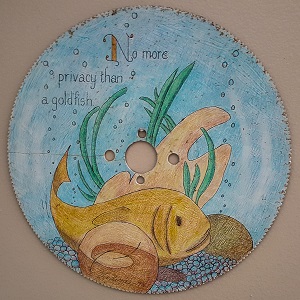
Over the years this sawblade has hung in various places in my different homes. It is always a reminder to me of the annoying reality that in some ways, we all live in the spotlight of others opinions and observations. Those of us in positions of leadership, whether in our home, work, or community, have to effectively handle being under the scrutiny of all sorts of people, knowing we influence others by what we say and do.
Take for example, poor Punxsutawney Phil. This famous groundhog is minding his own business, probably taking a long comfortable snooze in his den. He wakes up and wanders outside, and the next thing you know someone has grabbed him and all these photographers are taking snapshots. And whether he likes it or not, his shadow is said to forecast six more weeks of winter, the thought of which makes many people unhappy.
The truth is, no matter how hard we try to hide, we will at some point be exposed to the light of day. No matter how dark the night may be, in the end the earth will turn just enough the sun will shine on us again. No matter how gloomy our prospects, there is hope.
I believe there is a reason God ordained that the sabbath and holy days he gave his people Israel began in the evening. Each day began with rest during the darkness, which culminated with a new day of life. When the Word of God arrived on the scene, he showed up in the middle of the night, when it was dark. It was the entrance of God himself into our humanity, into our cosmos, which turned our night into a bright new morning.
Indeed, this motif is carried into Jesus’ last moments on the cross. There was some concern he would not be dead before sundown—the Jews didn’t want to be messing with anything like this when they were to be resting and observing a holy time. As the evening darkness approached, though, Jesus neared death. And then the sky darkened, and Jesus felt the full impact of our sense of our alienation and lostness.
Jesus went down into the depths of death—the blackness which has hovered over us since Adam and Eve’s missteps in the Garden of Eden. He experienced the full impact of our suffering and willingly bled and died. He was not overcome by death or darkness or evil. No, he entered into it, and then turned it on its head.
This shows the incredible love and compassion of our God who is Light. The Light entered our darkness. For him, our darkness was not a problem, because he was and is the Light—darkness does not impact him or alter him—he is the Creator and Sustainer of all things. Light and dark in this world only exist in and through him. Even evil has its existence only in what some call the permissive will of God. It is only by God’s grace such things continue.
So, we see Jesus was laid in a tomb, buried just as every other human is in some way upon death. He laid in the grave—the ultimate blackness and darkness we tend to fear as humans. But the grave could not and did not hold him. The next scene of the story shows the light of a new day dawning, and the stone rolled away from the tomb. We see the living Jesus speaking to his disciples and eating with them.
Whatever darkness we may face in this life, it is swept up into this darkness which Jesus experienced. Whatever death may come about in our lives is now a sharing in Christ’s death. Whatever dark moments we find ourselves in are a participation in those dark, bleak moments Jesus experienced in Gethsemane, on the cross, and in the tomb. No doubt, Jesus experienced just about every form of darkness we as human beings experience—being rejected and forsaken by his friends and family, being hated by the people who should have welcomed and embraced him, and being abandoned in his darkest hour by those who promised to be with him.
The miracle of Jesus’ ability to see in the dark was based in his eternal perichoretic relationship with his Abba in the Spirit. Jesus had true night vision. Our darkness was not too dark for him to enter—but rather the very place he came to in order to draw us up into the Triune relationship of love and life. Jesus dove into the blackness to rescue us from “the domain of darkness” and to transfer us to his kingdom as Abba’s beloved Son. (Col. 1:13 NASB)
Often our inability to see in the darkness, in the night of our brokenness in this world of shadows is because we are spiritually blind. We need to come to Jesus, like the blind men in Matt. 20:33 and say with them, “Lord, we want our eyes to be opened.” Jesus’ compassion is great, and he wants us to be able to see—he wants us to have true sight, especially in the dark night of our soul.
Too often we think we are seeing when in reality we are blind. We need Jesus to clear our eyes up so we can truly see as we ought. We need to guard against allowing ourselves to be deceived into thinking we are living and walking in the light, filled with the light of Jesus by the Spirit, when we are actually dwelling in and soaking up the darkness of unbelief. (Luke 11:33-36) Are we walking by faith or by sight?
What we can forget sometimes is, wherever we are, whatever we are doing, God is present and aware. Whatever we are experiencing in our lives, Jesus is intimately aware of and sharing in by the Spirit. We are not alone. Like the goldfish in a bowl, God sees everything about us, in us, and with us. He knows us down to our core and has shared it all with us in Jesus. He is present by his Spirit in every moment and in every situation. We are never left alone in the dark.
Abba, thank you for not leaving us alone in our darkness. Thank you, Jesus, for coming here and penetrating our darkness, overcoming it by your marvelous light. May you by your Spirit give us perfect night vision—the ability to see what is real and true: the great and never-ending, all-encompassing love and grace of you, our glorious God, and to know you are always in us, with us, and for us, through Jesus our Lord. Amen.
“If I say, ‘Surely the darkness will hide me and the light become night around me,’ even the darkness will not be dark to you; the night will shine like the day, for darkness is as light to you.’” Psalm 139:11-12 NIV
 Our Life in the Trinity