
Creator
Our Hope in Christ
By Linda Rex
April 20, 2025, Resurrection of the Lord | Easter—He is risen! He is risen indeed! As we come to this Resurrection Sunday, we enter into this new season with joy and gratitude for all Jesus Christ has done for us in his life, death, and resurrection. We look forward to celebrating the ascension of our Lord, and at Pentecost, the giving of his Holy Spirit from our heavenly Father.
In our first New Testament passage for this Sunday, 1 Corinthians 15:19–26, the apostle Paul reminds us that the hope we have in Jesus is not just for this life, but is also for the life to come. This begs the question—what is most important to us? Are we focused on what we can get out of this life? Are we focused on what we can experience right now? Or do we understand there is much more to real life than just this current human existence?
When God created this cosmos, he made wonderful, amazing things beyond our ability to count or fully measure. He gave us intricate, marvelous bodies and minds, which enable us to do tremendous things, especially when we work together in community with others. Our world is full of beautiful, and ugly, and strange, plants and animals, fish, and birds. The huge variety of insects blows my mind, not to mention the intricate and delicate creatures that are so small, they cannot be seen with the naked eye. But every one of these creatures and people will one day die.
We have given much to enjoy. And what a wonderful planet we get to live on! How marvelous that we have air to breathe and water to drink—when we don’t, it becomes a tragic problem. Apart from the grace of God, though, human beings have no way of ensuring that our life on our precious earth will outlast our human proclivity for self-destruction. I was looking at the Doomsday Clock, and according to Google’s AI, in 2025, the Doomsday Clock was set to 89 seconds to midnight. Our human efforts to avoid this catastrophe seem to be limited, and apart from God’s grace, we really have no hope for tomorrow.
The reason we struggle is because we really are very much like the biblical first man, Adam, who set aside his freedom to walk and talk with his Creator, in order to go his own way. He and Eve could have chosen to eat from the tree of life and all the others trees and plants in the garden of Eden. But instead, they chose to reject God’s invitation, and to eat the fruit of the tree of the knowledge of good and evil. By choosing to decide for themselves what it means to truly live, humans brought death into their world.
How often do our choices as human beings bring about death instead life! Think about your own personal history—have you made some choices in your life that took you down the wrong road? Have you experienced death to your plans, death to your dreams, even the death of those near and dear to you? If we are honest with ourselves, we have to admit that in our own lives, we are not much different than Adam. Death is a natural part of our human existence, and coming to the place of annihilating ourselves in some manner is not that strange a phenomenon for many of us.
This is why the apostle Paul says that if our only hope in Christ is in this life, we are pitiful creatures. Our hope is in the One who lived our life, died our death, and rose again. Jesus Christ’ bodily resurrection means that you and I not only have hope in this life, but also for the life to come. Death is the natural outcome of our human existence, but because of Jesus, we have hope that one day, we will live again. When Jesus returns in glory and ushers in a new heaven and earth, we will be given what the apostle Paul calls spiritual bodies. In that day, we will live a brand-new existence in an even more marvelous environment, in the presence of our Triune God. What a hope we have been given because Jesus is risen! He is risen indeed!
This life becomes fuller and more wonderful when we recognize and begin to live in the reality that, in Christ, we are God’s own adopted, beloved children. When we realize that we are forgiven, accepted, and included in the life and love of our Triune God, our whole existence changes. When we open ourselves up to reality that we have been baptized in the Holy Spirit, all of a sudden, we are met with the comfort and peace of a divine personal Companion and Friend, who never leaves us, but is always with us. We discover that we have a heavenly Father who adores us, and wants to be with us from now on, into eternity.
Life in this world, becomes richer, as we participate in our spiritual family, the Church. And our hope for eternity grows brighter, for we know that these relationships will not come to an end, but only grow deeper and healthier and happier in the world to come. We have great reason to hope, not just in this life, but in the life to come, because Jesus is risen. He is risen indeed!
Our heavenly Father, thank you for loving so much, that you determined from the beginning to include us in your life and love. Thank you, Jesus, for sharing our human existence, so that one day we may share in your life with your Father in the Spirit in the new heaven and earth. Thank you, Holy Spirit, for not only breathing life into us, but giving us new life in and through Jesus. May we ever celebrate our participation in Jesus’ death and resurrection, with gratitude and praise. Amen.
“If we have hoped in Christ in this life only, we are of all men most to be pitied. But now Christ has been raised from the dead, the first fruits of those who are asleep. For since by a man came death, by a man also came the resurrection of the dead. For as in Adam all die, so also in Christ all will be made alive. But each in his own order: Christ the first fruits, after that those who are Christ’s at His coming, then comes the end, when He hands over the kingdom to the God and Father, when He has abolished all rule and all authority and power. For He must reign until He has put all His enemies under His feet. The last enemy that will be abolished is death.” 1 Corinthians 15:19–26 NASB
“For behold, I create new heavens and a new earth; and the former things will not be remembered or come to mind. But be glad and rejoice forever in what I create; for behold, I create Jerusalem for rejoicing and her people for gladness. I will also rejoice in Jerusalem and be glad in My people; and there will no longer be heard in her the voice of weeping and the sound of crying. No longer will there be in it an infant who lives but a few days, or an old man who does not live out his days; for the youth will die at the age of one hundred and the one who does not reach the age of one hundred will be thought accursed. They will build houses and inhabit them; they will also plant vineyards and eat their fruit. They will not build and another inhabit, they will not plant and another eat; for as the lifetime of a tree, so will be the days of My people, and My chosen ones will wear out the work of their hands. They will not labor in vain, or bear children for calamity; for they are the offspring of those blessed by the LORD, and their descendants with them. It will also come to pass that before they call, I will answer; and while they are still speaking, I will hear. The wolf and the lamb will graze together, and the lion will eat straw like the ox; and dust will be the serpent’s food. They will do no evil or harm in all My holy mountain,’ says the LORD.” Isaiah 65:17–25 NASB
[Printable copy: https://lifeinthetrinity.blog/wp-content/uploads/2025/04/olitour-hope-in-christ.pdf ]
[More devotionals may be found at https://lifeinthetrinity.blog ]
[Subscribe to Our Life in the Trinity YouTube channel at https://www.youtube.com/@ourlifeinthetrinity ]
Our Risen Life
By Linda Rex
February 16, 2025, 6th Sunday in Epiphany—As we move into the 6th Sunday in the season of Epiphany, our Gospel passage describes Jesus’ ministry among the common people of his day. Many of them gathered around him to hear him preach. They also came to be healed of their diseases, for they heard of his miraculous power to heal and to cast out demons (Luke 6:17–26).
For many, these miracles drew them to Jesus in hopes of a coming messianic age of freedom from Roman oppression. But Jesus had some powerful words to say about the kingdom of God which began with his presence and power at work in the world. He proclaimed blessings on the poor, hungry, and sorrowful, as well as on those who were hated, ostracized, and insulted for his name’s sake. Jesus reminded those who focused on being well-fed, happy, and well-thought-of in this world, that all of these things would one day disappear. There were more precious kingdom values they needed to embrace other than being well thought of, well fed, and happy.
Luke wrote this gospel to people who were facing such difficulties for the sake of believing in Christ, and he wanted them to stand strong in spite of such spiritual opposition. In the same way, the apostle Paul wanted the believers in Corinth to have a correct understanding regarding the resurrection of the dead, for this impacted their ability to stand firm in the face of cultural influence, spiritual opposition, and persecution. Paul’s culture believed in the immortality of the soul, and the Greek notion of rejecting/restraining/indulging the human body while elevating the human spirit, a dualism God never intended. In contrast, Scripture teaches that we are embodied spirits, beloved by God, the Creator, who proclaimed from the beginning that what he created was very good (Gen. 1:31).
It was important for the church in Corinth to be reminded of the simplicity of the gospel as revealed in Jesus Christ. In the argument Paul uses in 1 Corinthians 15:12–20, our New Testament passage for this Sunday in Epiphany, he emphasizes that Jesus was resurrected from the dead, therefore we are forgiven of our sins. The Christian faith includes much more than just Jesus dying on the cross, which often is the focus of much Christian teaching. Jesus’ death on the cross is culminated by his resurrection from the dead. But even more than that, which Paul does not mention here, but mentions elsewhere, the Son of God took on our human body to live here on earth as Jesus Christ (Col. 1). It is God in human flesh, in the person of Jesus Christ, who lived our life, died our death, and rose again, who saves us from our sins.
This is why the call to faith in Christ is so important. We embrace the reality that our life as human beings was and is taken up in Jesus’ own life in a body here on earth, and that we died with him and we rose with him. That is a central tenet to the Christian faith. We trust in his perfect work in our place on our behalf. It is his life in us by his Spirit which is transformative and healing.
The apostle Paul says that Jesus is “the first fruits of those who are asleep.” The wave sheaf offering that ancient Israel offered during the spring festival, on the Sunday we celebrate now as Resurrection Sunday or Easter, was the offering of the first of the crop harvested. It was representative of the rest of the harvest to follow (Lev. 23:9–14). In the same way, Jesus’ self-offering is representative of all of us who will, because of his resurrection, participate in the resurrection of the dead.
Ancient Israel was told not to partake of the blessings of the new crop or harvest until this offering had been made. The point was not to restrict their enjoyment of their blessings, but to remind them of the central tenet of our faith—our provision, our deliverance, and our new life is in God alone, not in our own human efforts.
We can work hard to bring about a harvest by planting, cultivating, and watering. We do need to participate in the process. But apart from the grace of God which ensures the success of the reproductive and photosynthesis processes, there is no harvest at all. In the same way, our salvation is in Christ alone. Our faith is valueless apart from the perfect work of his self-offering in our place, on our behalf. We do not trust in our own efforts to save ourselves, but in his completed work of saving us—in his death and his resurrection from the grave. It is his life at work in us and through us by his Spirit, which ensures our risen life. By the Spirit, we can begin to experience our new life in Christ even now. And one day, when Jesus returns in glory, we will receive glorified bodies perfectly fitted for the new earth on which we will dwell for eternity. We look forward to that day.
Father, Jesus, Spirit, thank you for giving us new life. We know that one day, each of us will die—our life in this world will come to an end. Thank you, Jesus, that bearing our human body, you have died and risen, bringing each of us with you even now into your own life with our Father in the Spirit. Grant us the grace to trust in your perfect work, that we may rise with you in glory. Amen.
“Now if Christ is preached, that He has been raised from the dead, how do some among you say that there is no resurrection of the dead? But if there is no resurrection of the dead, not even Christ has been raised; and if Christ has not been raised, then our preaching is vain, your faith also is vain. Moreover we are even found to be false witnesses of God, because we testified against God that He raised Christ, whom He did not raise, if in fact the dead are not raised. For if the dead are not raised, not even Christ has been raised; and if Christ has not been raised, your faith is worthless; you are still in your sins. Then those also who have fallen asleep in Christ have perished. If we have hoped in Christ in this life only, we are of all men most to be pitied. But now Christ as been raised from the dead, the first fruits of those who are asleep.” 1 Corinthians 15:12–20 NASB
[Printable copy: https://lifeinthetrinity.blog/wp-content/uploads/2025/02/olitour-risen-life.pdf ]
[More devotionals may be found at https://lifeinthetrinity.blog ]
[Subscribe to Our Life in the Trinity YouTube channel at https://www.youtube.com/@ourlifeinthetrinity ]
Offered Once For All
By Linda Rex
October 27, 2024, Proper 25—As we have been touching down here and there in the book of Hebrews, we have been learning about Jesus Christ serving as our high priest now that that he has risen from the grave and ascended into heaven. We’ve looked at Jesus and his intercessory role in our lives, and how he ever offers our worship and praise to our Father, and offers the Father’s gifts, his Word, and his love and grace to us in the Spirit.
Perhaps you’ve heard that old phrase, “There’s nothing so certain as death and taxes.” In our New Testament passage for this Sunday, Hebrews 7:23–28, this book’s author notes that in the original tabernacle which we read about in the book of Exodus and Leviticus, the high priest was appointed according to the law. This high priest would eventually die, and another would be appointed in his place. This meant that as time went by, the role of high priest was continually being filled by different people. Death limited the ministry of those who offered this service of high priesthood to God and the people of ancient Israel.
Jesus Christ, on the other hand, while in his human flesh did die, but then he, being the Son of God, rose from the grave. Because he remains both God and human, Jesus lives forever and will never die. Jesus has been appointed our high priest according to the Father’s promise, which will never be broken. We can take comfort that nothing, not even death, can separate us from Jesus and his love for us (Rom. 8:38–39). There is continuity in Jesus’ ministry to us in the Spirit, and we can rest assured that he will always be there for us, offering us grace in our time of need, as we draw near to him.
As our high priest, Jesus offered up the perfect sacrifice—himself. He does not need to continually offer up new animal sacrifices like the ancient high priests were required to. No, he simply offered himself, in our place on our behalf, just once, and offers himself continually on our behalf, in every moment, on into eternity. Jesus has no sin in himself that needs to be dealt with through sacrifice as the ancient high priests constantly had to concern themselves with. Rather, Jesus is without sin, holy in character, and flawless and undefiled. So what he offers—himself—is the perfect sacrifice. Not only did his self-offering only have to be done once, it also was an offering that includes all people, and all that God has made in and through Jesus, and it lasts forever.
Because of who Jesus is as the Creator and Redeemer of all things, his sacrifice has tremendous power to redeem, restore, and renew. We celebrate the wonderful gift of new life that Jesus gives us, and we rest in his faithful intercession in our place on our behalf before his Father in the Spirit. Jesus is constantly at work making all things new—this is his word to us through the apostle John (Rev. 21:5; 2 Cor. 5:17). And we look forward to when Jesus will return in glory and renew all things as he ushers in the new heaven and earth. What a glorious hope we have in Jesus!
Now, if you thought that is good news, just consider how wonderful it is that we do not have to try and work things out with a distant, uninvolved, uncaring God. This Jesus Christ who we trust in is the Son of our heavenly Father, with whom he lives in close relationship in the heavenly Spirit. There is an eternal relationship of love and grace that Jesus brought humanity right up into. And within that relationship of love and grace, we get to share by the Spirit in Jesus’ own sonship, in face-to-face oneness with his Father. We are not left trying to figure out some way to make ourselves right with God, or trying to make ourselves good enough or acceptable enough to be worthy of God’s love, attention, or grace. Instead, we are simply able to rest in and revel in the joy of participating in Jesus’ own oneness with his Father in the Spirit, as we trust in Jesus’ finished work. This motivates us to live a life of gratitude and obedient service to the Lord who both created us and redeems us. Praise God!
Dear Jesus, thank you for the amazing gift you have given, in giving yourself so generously and freely in our place on our behalf. Thank you for ever interceding for us and for bringing us home to our Father to be with him forever in the Spirit. We praise you for your glorious work! Amen.
“The former priests, on the one hand, existed in greater numbers because they were prevented by death from continuing, but Jesus, on the other hand, because He continues forever, holds His priesthood permanently. Therefore He is able also to save forever those who draw near to God through Him, since He always lives to make intercession for them. For it was fitting for us to have such a high priest, holy, innocent, undefiled, separated from sinners and exalted above the heavens; who does not need daily, like those high priests, to offer up sacrifices, first for His own sins and then for the sins of the people, because this He did once for all when He offered up Himself. For the Law appoints men as high priests who are weak, but the word of the oath, which came after the Law, appoints a Son, made perfect forever.” Hebrews 7:23–28 NASB
“The fact that there were so many priests shows how frequently they died and had to be replaced. But there will be no successor to the Priesthood of Jesus because he remains forever. Through him mankind’s approach to God is forever secured; he continues to communicate the full accomplishment of their salvation. As our High Priest he towers far above every other priestly system in conspicuous prominence and in holy character. His guileless, flawless life on earth was never compromised by sin, and he himself was exalted above the heavens where he occupies the highest rank of authority in the eternal realm. Unlike the previous high priests whose system of daily sacrifices was a constant reminder of their own failures, he had no need to sacrifice on his own behalf. The sacrifice he offered was himself for all; a sacrifice never to be repeated. Under the law, men were appointed as high priests regardless of their weaknesses. The word of the oath, which succeeded the law, appointed the son in perpetual perfection.” Hebrews 7:23–28 Mirror Bible
[Printable copy: https://lifeinthetrinity.blog/wp-content/uploads/2024/10/olitoffered-once-for-all.pdf ]
[More devotionals may be found at https://lifeinthetrinity.blog ]
[Subscribe to Our Life in the Trinity YouTube channel at https://www.youtube.com/@ourlifeinthetrinity ]
The Gentleness of Wisdom
By Linda Rex
September 22, 2024, Proper 20 | After Pentecost—As we get further into our election year here in the United States, I am concerned by the way in which we as human beings tend to be swayed by whatever wind of politics blows in our direction. Those of us who believe and follow Jesus can get caught up in the polarization which seems to be occurring during this season, allowing ourselves to be swept along with one party’s aims and ambitions, rather than remaining rooted in our Lord, and his will and ways.
In our New Testament reading for this Sunday, James 3:13–4:3, 4:7–8a, the apostle expresses his concern about the wisdom of those who zealously sought the deliverance of his people from their Roman oppressors. The wisdom they expressed in words and actions led these people toward violence as a means of overthrowing the current government. James saw what drove their response was not the love of God in Christ, but jealousy and selfish ambition. There were those who saw what those in power had and enjoyed, and desired to have it for themselves. This led them to act in ways which did not reflect Christ, but rather, the natural and even demonic tendency towards evil and disorder.
What James speaks about is something which, when we look at our own hearts and minds today, may be a cause for concern. What are our motives for our response to the current situation we find ourselves in? What are our motives for what we do, whether at work, at home, or as we serve in our community or church? Are we motivated by God’s love in Christ, or are we motivated by jealousy and selfish ambition? Sometimes we may believe we have the greatest of intentions, when, in reality, we have ulterior motives. We may need to ask the Lord to show us what’s really going on inside.
If we truly want to be wise and understanding, James says that our wisdom is to be rooted in God himself. True wisdom, he says, is pure—it has no ulterior motives. Just like what Jesus manifested while he was here on earth, it comes simply out of a heart that is “peaceable, gentle, reasonable, full of mercy and good fruits, unwavering, without hypocrisy.” This sincere and quiet spirit reflects the union and communion of the divine oneness of Father, Son, and Spirit, where each Person fully knows and indwells the other, in a relationship of other-centered, self-giving, sacrificial love. This beautiful shalom, the wholeness and peace of the Triune God, is held by James in stark contrast against the “earthly, natural, demonic” wisdom expressed by those who were embracing a path which led to evil and disorder.
So, what does James say we are to do instead? Because our Triune God, who is love and who loves us, is our Creator and Redeemer, we submit to him. We voluntarily yield ourselves to the authority of Father, Jesus, and Spirit in our hearts, minds, and lives. We resist all that is evil and that spirit which stands in opposition to God’s will and his ways. We choose to draw closer to God, growing in our relationship with him day by day. In response, God will draw closer to us.
Jesus Christ has cleansed us and is cleansing us now by the work of the Holy Spirit in and with us. Jesus purified our hearts through his perfect work in our place on our behalf, and is working now to purify our hearts by his Spirit as we respond to him in faith. Our response to the Holy Spirit’s work in us and in our lives is important. We can resist or grieve the Spirit, or we can respond with humble submission, gratitude, and obedience. True wisdom involves a humble, obedient response to the Spirit’s work, allowing the Spirit to cleanse us and purify our hearts with the indwelling presence and power of Jesus Christ. The wisdom from above, God’s wisdom, has been given to us through Jesus in the Spirit. Are we yielding fully to the Spirit’s work in and through us? Are we allowing him to transform us, and to form us to Christ?
I began this message with a reference to what is happening in the political sphere in our nation today. How might God’s wisdom be applied to this situation? The reality is, as followers of Christ, our first loyalty is to our Lord and Savior, to Jesus. And we are to draw near to him, for he is the One who ultimately is Lord over the nations, and who elevates or demotes our leaders. And we are unable to clearly see and make the best determination of how to move forward apart from his direction and inspiration by his heavenly Spirit. So, we pray for our nation and for God’s Spirit to move in people’s hearts and minds. We ask God to do what only God can do, and as we are directed by him, we act in the gentleness of his divine wisdom.
Heavenly Father, thank you that you know exactly what is needed in our situation, and that you are ever at work in our lives, growing us into the fullness of Christ. Grant us the grace to respond to your work in us by your Spirit, and to yield ourselves to your will in obedience, through Jesus our Lord. Amen.
“Who among you is wise and understanding? Let him show by his good behavior his deeds in the gentleness of wisdom. But if you have bitter jealousy and selfish ambition in your heart, do not be arrogant and so lie against the truth. This wisdom is not that which comes down from above, but is earthly, natural, demonic. For where jealousy and selfish ambition exist, there is disorder and every evil thing. But the wisdom from above is first pure, then peaceable, gentle, reasonable, full of mercy and good fruits, unwavering, without hypocrisy. And the seed whose fruit is righteousness is sown in peace by those who make peace. What is the source of quarrels and conflicts among you? Is not the source your pleasures that wage war in your members? You lust and do not have; so you commit murder. You are envious and cannot obtain; so you fight and quarrel. You do not have because you do not ask. You ask and do not receive, because you ask with wrong motives, so that you may spend it on your pleasures. … Submit therefore to God. Resist the devil and he will flee from you. Draw near to God and He will draw near to you. Cleanse your hands, you sinners; and purify your hearts, you double-minded.” James 3:13–4:3, 4:7–8a NASB
Seated on a Donkey’s Colt
By Linda Rex
March 24, 2024, Palm Sunday | Preparation for Easter or Lent—This morning as I was reading one of the passages for this Palm Sunday, Mark 11:1–11, I was struck by the marvel of Jesus riding a donkey’s colt which had never been ridden before. Indeed, the more I thought about, the more astonished I became that he was even able to ride the young animal at all.
I suppose it is possible that the colt was familiar with Jesus, but even so, most animals are not thrilled about having things placed on their back such as the cloaks and coats which the disciples threw over the back of this colt. Not to mention having to bear the weight of a human being, which is normally a new and frightening experience for an untrained, full-grown donkey or horse. Perhaps these are stereotyped concepts, but what I recall about donkeys having things placed on their back which they don’t want there, is that those items or people ultimately end up back on the ground, unceremoniously dumped off by the animal.
But in this remarkable event, the disciples place their garments on the colt, and Jesus climbs on. The crowds of people are throwing clothing and tree branches on the ground in front of this animal, while shouting and singing and waving branches around. What kind of animal would take this calmly, especially when it had never been ridden before? Perhaps the only answer is what Jesus told the Jewish leaders of his day who complained about all the hubbub, that if he wasn’t praised by the people, the stones themselves would cry out.
Creation knows its Maker, and celebrates its Sustainer and Provider in each moment simply by being who and what it is—his creation. The trees and bushes, and plants praise God simply by doing what trees, bushes and plants do—raise their heads towards the sun, put on leaves and flowers, bear fruit, breathing in the carbon dioxide and breathing out oxygen as their participation in God’s provision for this planet and its inhabitants. The animals praise God simply by being what God created each of them to be—and here this donkey had the privilege of doing something special for its Creator—bearing the King of Israel into Jerusalem while the people shouted “Hosanna! Blessed is he who comes in the name of the Lord!”
It’s significant that Jesus did this entry into Jerusalem on the back of this young donkey. Jesus chose a colt of a donkey, to show his humility. He allowed the people to joyfully express their understanding of the prophetic significance of the spring festival, even though he knew that the Passover lamb that year would be something other than what anyone there expected. The Lamb of God would lay down his life and be crucified at the hands of those whom he had made.
As human beings, we so often get our focus upon our human kingdoms. We make our plans and have our expectations about how things are going to work out. We may even tell God how it’s going to be—letting God know what needs to be done when and how and why. We dress it all up in religious fervor at times, and don’t even realize that what we are dreaming of and hoping for and expecting isn’t at all what God has in mind.
In God’s economy, the path to glory is not through the palm frond laden streets of the city. The path to glory, when God is in it, is not always filled with shouts of adulation and praise. I am learning that often God’s path to glory is the path into and through death to resurrection. First must come the humiliation, service, and sacrifice. Then will come the exaltation.
In the second gospel reading for this Sunday, John 12:12–16, we see that it took Jesus’ resurrection, his giving of the Spirit, and his revelation of the Scriptures before the disciples began to understand that what Jesus went through was long predicted in the prophetic Word. The One who holds all things together, to whom creation gives its praise, took the path of humility for our sakes, because of his love and grace. And even a humble colt of a donkey knew that he was safe in his Creator’s hands and did his part, for the glory and praise of his Lord, the King of all.
Creator and Sustainer of all that is, thank you for giving us life. Grant us the grace to remember who we are—those created by you to share life with you, to be loved by you and so to love others. May we learn rest in simply being those you created us to be—your beloved children—and to do as you ask in every moment, through Jesus our Lord and by your Spirit. Amen.
“As they approached Jerusalem, at Bethphage and Bethany, near the Mount of Olives, He sent two of His disciples, and said to them, ‘Go into the village opposite you, and immediately as you enter it, you will find a colt tied there, on which no one yet has ever sat; untie it and bring it here. If anyone says to you, “Why are you doing this?” you say, “The Lord has need of it”; and immediately he will send it back here.’ They went away and found a colt tied at the door, outside in the street; and they untied it. Some of the bystanders were saying to them, ‘What are you doing, untying the colt?’ They spoke to them just as Jesus had told them, and they gave them permission. They brought the colt to Jesus and put their coats on it; and He sat on it. And many spread their coats in the road, and others spread leafy branches which they had cut from the fields. Those who went in front and those who followed were shouting: ‘Hosanna! “Blessed is he who comes in the name of the Lord”; Blessed is the coming kingdom of our father David; Hosanna in the highest!’ Jesus entered Jerusalem and came into the temple; and after looking around at everything, He left for Bethany with the twelve, since it was already late.” Mark 11:1–11 NASB
“On the next day the large crowd who had come to the feast, when they heard that Jesus was coming to Jerusalem, took the branches of the palm trees and went out to meet Him, and began to shout, ‘Hosanna! “Blessed is he who comes in the name of the Lord”, even the King of Israel.’ Jesus, finding a young donkey, sat on it; as it is written, ‘Fear not, daughter of Zion; behold your king is coming, seated on a donkey’s colt.’ These things His disciples did not understand at the first; but when Jesus was glorified, then they remembered that these things were written of Him, and that they had done these things to Him.” John 12:12–16 NASB
[Printable copy: https://lifeinthetrinity.blog/wp-content/uploads/2024/03/olitseated-on-a-donkeys-colt.pdf ]
[More devotionals may be found at https://lifeinthetrinity.blog ]
[Subscribe to Our Life in the Trinity YouTube channel at https://www.youtube.com/@ourlifeinthetrinity ]
New Beginnings
By Linda Rex
May 23, 2021, DAY OF PENTECOST—Recently while on vacation, I pulled out an empty canvas and some acrylic paints a dear friend had left me, and began to paint. Staring at an empty canvas that needs to be filled is a lot like staring at an empty page and trying to figure out what to write. There are so many possibilities ahead that one hardly knows where to begin. Consider for a moment what it was like as the Spirit hovered over the waters, as everything was without form and empty.
In times past I have avoided painting due to the difficulty I have in controlling the outcome. The brush has a mind of its own and I cannot always get it to do what I want. My preferred method of artwork usually involves colored pencils or pen and ink for this very reason. But there is a loss of freedom in such control of the outcome.
But the Creator sees things differently—he gives each and every thing which he creates an incredible freedom. He does not need to control every movement and every decision—otherwise we would all be robots. Instead, God allows each tree, plant, fish, bird, animal, and human to be who he created them to be. By his creative Spirit, he moves in all he has made to accomplish his purposes, but always with this element of true freedom based in his love.
This creates a built-in risk for our Creator—what if a creature he has made decides to live in a way which is different from his design? When my brush takes off across the canvas in a way I didn’t plan for, I get frustrated—in my mind, I now have a big mistake to rectify. But what if mistakes are part of the picture? What if the possibility of something not turning out in the way I expected actually ends up adding to the result, making it better?
What we find is that the Creator of all things planned in advance for this reality in what he created. We discover in the written Word of God that even before he created all things, the Maker of all had a plan to redeem and restore his creation should it wander away from its intended life path. He made our mistakes a part of his picture—redemption and restoration in and through the gift of his Son was allowed to be an essential part of his creation process. In fact, God always meant to include us in his life and love—and our turning away from him did not prevent this purpose from being realized.
Think about the history of human beings and how God has worked in and through each one to accomplish his purpose. Over the millennia before Christ, we find kingdoms rose and kingdoms fell, people lived and died, children were born and grew up. Through all these events, natural calamities, and over a long period of time, the creative Spirit worked. God even included certain people in his efforts—calling Noah to build an ark, Abraham to leave his country and people, and Moses to lead Israel out of Egypt. Flawed people included in his plan—and yet the Creator continued his masterpiece.
Indeed, we find that all along God was working to restore and renew his creation, and allowing us as broken human beings to be a part of the process. When he sent his Son, we find angels celebrating this momentous event. Now God had moved even closer to his creation—he had taken on human flesh to live and walk on earth as one of us! The divine Painter had himself become the brush in the hand of the creative Spirit!
How amazing that God reconstructs the creatures he made in his image from the inside out. He enters our space and time, experiences our limitations and frailties, and begins to redeem and restore as one of us. He develops personal relationships with those he made and begins to teach them what it means to be truly human, demonstrating it by the way he lived. Rather than being enslaved by the sin which controls us, he conquered it, taking it all the way to the cross and delivering us from it through death and resurrection. And then he took our humanity up with him into the presence of the Father—our humanity restored and renewed in his person, dwelling forever with God as was always intended.
Jesus told his disciples when he left at ascension that he would not leave them as orphans. He was going to send them the Spirit, the other Helper like himself, who would be with them forever. The creative Spirit was poured out on all flesh from the Father by Jesus so that we all could participate in Christ’s true humanity. Instead of the masterpiece being so flawed that it must be thrown out, all God has made has incredible possibilities in store!
Think for a minute about Judas Iscariot, the son of perdition. This man had many choices in his life, the capacity to be a true follower of Jesus Christ. But he was given over to thievery—often stealing money from the common purse. And when push came to shove, he sold the Savior for thirty pieces of silver. Here was a mistake beyond mistakes—selling the Messiah for a paltry sum so that he ended up being crucified.
But the crucifixion of Jesus Christ was a part of the masterpiece God was creating. It was not as though God wanted Judas to do this idiocy, but rather, that he included it as a necessary part of the picture. It was not God’s choice for Judas, but it was Judas’ choice, which God honored and allowed, using it to accomplish a greater purpose in the end, the redemption of all humanity.
What if, instead of focusing on our faults and failures, we offered them up to the creative Spirit to pour into them his recreative power to renew and redeem? What if we allow Jesus to be who he is—our Savior and Redeemer, the One who restores all things? What is it in your life and mine which needs to be reconstructed?
There may be a time of deconstruction first—God sometimes needs to remove some things so there is space for something new. But God’s purpose is to transform, heal and renew—and we can participate with him in that process. And who knows what the outcome will be? God says that through Christ and by the Spirit, it will be better than we can ever ask or imagine! His masterpiece—humanity transformed and renewed—will live with him forever in the new heavens and new earth, as we begin by his Spirit to experience this life in relationship with the Father and Son even now.
Thank you, Creator of all, for everything you have made and how wonderfully you have worked and will work to transform, heal and renew your creation. We invite you, Creative Spirit, to finish what you have begun in us and in our world. Keep our focus on you, Jesus, and the incredible possibilities that are ahead, because of all you have done and will do by your Spirit to the glory of the Father. Amen.
“When the day of Pentecost had come, they were all together in one place. And suddenly there came from heaven a noise like a violent rushing wind, and it filled the whole house where they were sitting. And there appeared to them tongues as of fire distributing themselves, and they rested on each one of them. And they were all filled with the Holy Spirit and began to speak with other tongues, as the Spirit was giving them utterance.” Acts 2:1-4 (5-21) NASB
“O LORD, how many are Your works! In wisdom You have made them all; | The earth is full of Your possessions. … You hide Your face, they are dismayed; You take away their spirit, they expire | And return to their dust. You send forth Your Spirit, they are created; | And You renew the face of the ground.” Psalm 104:24, 29-30 NASB
The House That God Built
By Linda Rex
December 20, 2020, ADVENT | LOVE—One of the things I love about the season of Advent is the beautiful and inspiring music. Playing and singing music which tells the story of God’s love and grace expressed in the coming of Jesus brings joy and comfort to many. One of the songs we often sing during Christmas is “The Twelve Days of Christmas”,(1) which as a cumulative teaching song is often accompanied by laughter and giggles as the singers vainly attempt to remember all twelve gifts.
Another cumulative song which is not Christmas-oriented but was used as a memory game for children’s parties years ago is an old nursery rhyme called “The House That Jack Built.” The last line of the song went something like this: “Here is the farmer who owned the rooster who woke the priest who married the tattered man who kissed the maid so forlorn who milked the cow with the crumpled horn who threw the dog who worried the cat who killed the rat who ate the grain which lay in the house Jack built.” As the game went on, each child would add another part of the story while repeating what had gone before, hopefully without mistakes.
The beginning of the rhyme was simply, “This is the house Jack built.”(2) In many ways, this is how everything started in our cosmos. We could simply say, “This is the cosmos, the world God created.” All that we know now and study so diligently with our telescopes and microscopes exists where once there was nothing, not even the building blocks of the universe. At God’s decision, through the Word of God and by the power and presence of the Spirit, all things came into existence. Simply said—what wasn’t became what was by God’s will, word, and power.
On this particular planet, there came a time when God brought forth plants and trees, animals, fish, and birds—abundant life of such variety we are still categorizing and sorting them today. The interwoven nature of the many forms of life on this planet constantly catch us by surprise—what happens to one creature often affects many others, as well as the biome in which they live. Like the animals in our nursery rhyme, no creature stands by itself—they are all interrelated and mutually affected by one another.
As creatures, we as human beings, are also affected by and interwoven with all that exists on this earth. As our understanding of science and technology have grown, many of us as humans have taken for granted our ability to manage and control our environment and planet. It is easy to forget that we are merely another creature dependent upon others and upon the God who made all things. We have come far enough today that God himself has become a forgotten story to many, one in which we see no need to believe. It is as though we have forgotten who built the house in which we live. We have put so many other things in his place, we believe we don’t need him anymore.
In 2 Samuel 7:1–11, 16, we find that King David decided that he wanted to built a house for the ark of God since it was still residing in the tabernacle God had told the Israelites to build for it. The tabernacle was designed to be moved about rather than to remain in one place. During the years of wandering in the wilderness and crossing into the promised land, the tabernacle was the place where Moses’ brother Aaron and the priests appointed by God ministered God’s grace to his people through offerings and sacrifices and the reading of the law. When the cloud of God’s presence lifted off the tabernacle, the people would pack their things and get ready to move, following wherever they were led.
When King David told Nathan he wanted to build a house for God’s presence, the prophet thought it was a great idea and told him to go ahead with it. But this wasn’t God’s preference—he told Nathan to tell King David that he had never lived in a house, but only in a mobile dwelling. He told Nathan to tell the king that one day God would build David a house, a kingdom that would last forever—God didn’t need David to build him a house.
The problem with humans building temples for God is seen in the very statement King David made to Nathan: “See now, I dwell in a house of cedar, but the ark of God dwells within tent curtains.” Do you catch it? David was worried about the ark, not about the presence of God himself. Too often, we as human beings get caught up in the rites and rituals, the law and sacrifices of our worship instead of focusing on interacting with God himself. When David’s son Solomon finished the work on the temple, it was filled with the Shekinah glory of God. But it wasn’t very long before King Solomon himself began worshiping the idols of his wives rather than growing in his own personal relationship with the God who had crowned him king.
Following his death, the northern half of the nation of Israel split off and created their own place of worship, abandoning the temple and worship of the Creator and Redeemer who had delivered them from slavery in Egypt. Eventually the northern tribes were taken into exile by the Assyrians, as the southern tribes (known as Judah) began to embrace idolatry and pagan religious practices as well. Eventually the Shekinah glory left the temple, due to the hedonistic practices being observed there. It wasn’t much longer before Judah was taken over by the Babylonians. Soon and for a time, this people who had been brought into covenant relationship with the Creator God himself were no longer residents in the land he had given them.
As you can see, even when we as humans are brought by God into relationship with himself and given all we need for that relationship, we so often trade it in for something tangible we can see, feel, hear, taste and touch. We can control worship to an idol—construct a house, bring offerings, say the right words, sing the right song. We believe that if we do this, the idol will do that, with such appeasement giving an illusion of control over the situation. But in all of this, there is no real relationship. Give us an ark we can put in a building and do nice things for—don’t make us have to interact with an intangible God we cannot predict or control, and who may ask us to change or do things his way!
It’s as though we are at the end of a long line of kids and we’re having to remember the entire nursery rhyme. We’re stuck somewhere between the house that Jack built and the farmer who has a crowing rooster. At this point we may be wondering why Jack even built the house at all. We’re not sure where we’re going, how we’re going to get there, but we’re not about to acknowledge defeat. What we don’t want to admit is, we’ll never be able to get the whole thing right on our own, no matter how hard we try.
The reality is that we cannot build a house for God to dwell in because, as the apostle Paul said: “The God who made the world and all things in it, since He is Lord of heaven and earth, does not dwell in temples made with hands; nor is He served by human hands, as though He needed anything, since He Himself gives to all people life and breath and all things; …” (Acts 17:24-25 NASB) Rather than us building a temple for God to dwell in, God came into our human flesh in Jesus Christ to create a space for himself within our humanity where he could dwell by the Spirit. In that place, our broken humanity, which we had filled with evil, sin, rebellion and disobedience, God in Christ forged a space for God’s presence by the Spirit, cleansing us and freeing us from evil, sin, and death.
As mobile dwellings of God himself by the Spirit, gathered together into the body of Christ—the spiritual temple of God, the church—we bring God’s kingdom into relation with the broken world around us, touching it with his presence and power by his Spirit. The church and its members are not a perfected temple yet, but are a place where sinners are being healed, transformed, and renewed as they walk in humble relationship with God through Christ in the Spirit. Even though the Spirit is present to all people at all times, not everyone opens themselves up by faith to the living presence of God in Christ—so the church participates with Christ in calling all people to the new life which is theirs in Jesus.
The reading from Luke for this Sunday describes when the angel Gabriel told Mary she was to have a baby who would be the Son of God, Jesus the Messiah. Mary was chosen to give birth to the Christ child, not because of her worthiness or goodness, but simply because of God’s grace and favor. She would carry in her womb the One who was both God and man—she would be a mobile temple for the presence of God in human flesh as an unborn infant.
What was Mary’s response to this announcement? It is the same response God longs to hear from each of us as he births Christ in us by his Holy Spirit: “…may it be done to me according to your word.” Humble surrender to the will and wishes of our mighty God as he forms Christ in us—this is our best response. What will we do with the house God has forged for himself in us? Will we echo Mary’s response? Or will we continue the merry-go-round of our nursery rhyme life of godlessness?
Heavenly Father, Creator and Sustainer of all, thank you for not abandoning us when we abandoned you. Thank you for sending your Son into our human flesh to forge a dwelling place for your presence. Forgive our rebellion and disobedience. Grant us a humble surrender to your will and wishes. Dear God, by your Spirit come and dwell in our hearts and lives, forming Christ in us and transforming our hearts by faith. May it be done to us according to your Word by your Holy Spirit. Amen.
“My soul exalts the Lord,
And my spirit has rejoiced in God my Savior.
For He has had regard for the humble state of His bondslave;
For behold, from this time on all generations will count me blessed.
For the Mighty One has done great things for me;
And holy is His name.” Luke 1:46b–49 NASB
See also Luke 1:28–33.
________________________
1) https://en.wikipedia.org/wiki/The_Twelve_Days_of_Christmas_(song) (accessed 12/11/2020)
2) https://en.wikipedia.org/wiki/This_Is_the_House_That_Jack_Built (accessed 12/11/2020)
And So He Reigns
By Linda Rex
November 22, 2020, Christ the King or the Reign of Christ— I think we may all agree that the year 2020 has been one of a kind. If it were true that there was no God and that we were merely highly evolved creatures hanging out here in the middle of empty space on a planet that will one day burn up and drop back into the sun, how hopeless and meaningless this whole experience has been!
The blessing of the Christian faith is that it points us beyond all that is occurring, and reminds us of the love and grace of God out of which all of this was birthed and by which all of this was redeemed and is sustained, and gives us great hope in the midst our messes and disasters. Even though evil happens—and it often does—we don’t need to lose hope. We have an anchor which holds us, the very presence of God in the middle of whatever may be going on. It is God’s presence through Christ in the Spirit which carries us through every circumstance, offering wisdom, strength, comfort and guidance when all we see is destruction, despair, and suffering. It is the ascending, triumphant Lord who gives us hope that this isn’t the end—that there is something so much more wonderful and amazing ahead of us!
God knew that when we made the choice to turn away from him to the things of our flesh and this world that the spiral down into death and nothingness would begin. He set our destiny in motion way before then, as God the Word was elected to one day enter our human flesh to rescue us from this fate and to bring us into union and communion with the Triune God so we might live with him forever. Evil, sin and death were destined to be destroyed, conquered on the cross and in the finished work of Christ as he rose from the grave and ascended to the Father carrying our glorified humanity with him into Abba’s presence.
On this Sunday we celebrate the culmination of all the days on the Christian calendar, having begun during Advent with the incarnation of Jesus Christ, moved through Epiphany and Lent to Easter week with Jesus’ crucifixion and resurrection, and on into Ascension Sunday and subsequently Pentecost with the sending of the Holy Spirit. We’ve gotten through the ordinary days, during which we have learned about how to live out this faith we have been given by expressing God’s love to those around us and holding fast to the hope we have in Christ. The summation today then, is Christ coming in his glory, sitting as King of Kings and Lord of all.
In the parable of the sheep and goats, we see the King Jesus sitting on his throne, passing judgment on all the nations. In spite of the Jewish expectation that Israel would be the nation of the kingdom of God, Jesus has included in his person those of every nation and people group. The line that our Lord draws between people who are in and those who are out does not have to do as much with our bad or good behavior, but more with our perception of and participation in who Jesus Christ is as our Savior and Lord. We are brought up against our identity as the image-bearers of God who are created to love him and each other. We are reminded of the reality that our brother or sister is made in the same image as ourselves and that the humanity Jesus took upon himself in the incarnation was our very own as he fully identified with us as human beings in his life, death, resurrection and ascension.
In this parable we see King Jesus say that the sheep on his right hand are those who perceived in the people who were poor, needy, imprisoned, thirsty and hungry, the person of Christ. To care for another person in a tangible way, especially those who are followers of Christ, is to care for Jesus himself. When we treat others with indifference, oppression, neglect and injustice, we are doing those very things to Jesus. We are pouring out once again all the evil, sin, and violence of the cross onto the innocent, humble and holy Lamb of God. In doing so we deny our need for Christ and his sacrifice, placing ourselves in his stead as lords of our cosmos and our world. It is no wonder that God’s judgment upon such a choice is that we will experience the reality of eternity without the grace of God since we have determined for ourself we have no need or desire for it.
So what is God’s heart toward humanity in the midst of all that is happening right now? It is the same that it has always been—he wants us to enjoy all the benefits and blessings of life in union and communion with our Creator, in joyful fellowship with one another, and in happy harmony with all he has created. This is what we were created for and destined for. In Christ, this is the future God has planned for us.
In Christ, we have been brought out of the kingdom of darkness into this kingdom of light. By faith we can begin to participate in this heavenly kingdom even now, living each moment in the presence of the King by the power of the Holy Spirit. Our acknowledgement of Jesus Christ as Lord of all means that he sits on the throne of our heart and has the final say in our lives right now. By faith, we participate in Christ’s face to face relationship with the Father in the Spirit, and enjoy moment by moment spiritual fellowship with God himself. We participate with King Jesus in what he is doing in this world, and by the power of the risen Lord, we overcome evil, sin and death in this world as we wait for Christ’s return in glory.
Just as King Jesus reigns even now over all, he will come one day in all his glory to eradicate once and for all the evil, sin, and death he conquered on the cross and will establish his throne forever in the new heavens and new earth. When that day comes, will we still be reigning over our own hearts and lives, thinking we are the supreme lords over creation and all that is in it? Will we be treating one another with indifference, oppression, neglect and injustice, or with the honor and respect and love due our risen Lord and Savior? Will we be trusting in ourselves and our goodness, or humbly acknowledging our desperate need for the grace and love of our Lord and King Jesus Christ, and so offering that same love and grace to our fellow human? These are questions worth wrestling with on this Sunday, as we reflect on the reign of Jesus Christ, soon to be established in glory, but at work even now in us and in this world.
Heavenly God—Holy Father, Son and Spirit—thank you for loving us so much that you did not want to spend eternity without us. Thank you for sending Jesus so we could be with you forever. Holy Spirit, enable us to love one another as you, God, have loved us. We acknowledge our desperate need for your grace and love expressed to us in Jesus. We receive this precious gift with gratitude and praise, through our Lord Jesus Christ, he who is King of all. Amen.
“For thus says the Lord GOD, ‘Behold, I Myself will search for My sheep and seek them out. As a shepherd cares for his herd in the day when he is among his scattered sheep, so I will care for My sheep and will deliver them from all the places to which they were scattered on a cloudy and gloomy day. I will bring them out from the peoples and gather them from the countries and bring them to their own land; and I will feed them on the mountains of Israel, by the streams, and in all the inhabited places of the land. I will feed them in a good pasture, and their grazing ground will be on the mountain heights of Israel. There they will lie down on good grazing ground and feed in rich pasture on the mountains of Israel. I will feed My flock and I will lead them to rest,” declares the Lord GOD. I will seek the lost, bring back the scattered, bind up the broken and strengthen the sick; but the fat and the strong I will destroy. I will feed them with judgment.” Ezekiel 34:11-16 NASB
“Shout joyfully to the LORD, all the earth.
Serve the LORD with gladness;
Come before Him with joyful singing.
Know that the LORD Himself is God;
It is He who has made us, and not we ourselves;
We are His people and the sheep of His pasture.” Psalm 100:1-3 NASB
“Come, let us worship and bow down,
Let us kneel before the LORD our Maker.
For He is our God,
And we are the people of His pasture and the sheep of His hand.” Psalm 95:6-7 NASB
See also Matthew 25:31–46 and Ephesians 1:15–23.
Night Vision
By Linda Rex
There is a sawblade hanging on the wall upstairs with the picture of a goldfish swimming around in a bowl. The text I wrote on the picture when I was done drawing it with colored pencils was: “No more privacy than a goldfish.” It seemed to fit.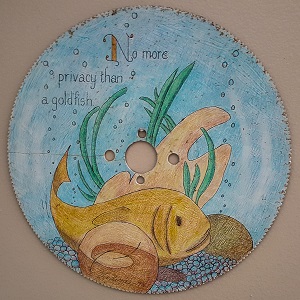
Over the years this sawblade has hung in various places in my different homes. It is always a reminder to me of the annoying reality that in some ways, we all live in the spotlight of others opinions and observations. Those of us in positions of leadership, whether in our home, work, or community, have to effectively handle being under the scrutiny of all sorts of people, knowing we influence others by what we say and do.
Take for example, poor Punxsutawney Phil. This famous groundhog is minding his own business, probably taking a long comfortable snooze in his den. He wakes up and wanders outside, and the next thing you know someone has grabbed him and all these photographers are taking snapshots. And whether he likes it or not, his shadow is said to forecast six more weeks of winter, the thought of which makes many people unhappy.
The truth is, no matter how hard we try to hide, we will at some point be exposed to the light of day. No matter how dark the night may be, in the end the earth will turn just enough the sun will shine on us again. No matter how gloomy our prospects, there is hope.
I believe there is a reason God ordained that the sabbath and holy days he gave his people Israel began in the evening. Each day began with rest during the darkness, which culminated with a new day of life. When the Word of God arrived on the scene, he showed up in the middle of the night, when it was dark. It was the entrance of God himself into our humanity, into our cosmos, which turned our night into a bright new morning.
Indeed, this motif is carried into Jesus’ last moments on the cross. There was some concern he would not be dead before sundown—the Jews didn’t want to be messing with anything like this when they were to be resting and observing a holy time. As the evening darkness approached, though, Jesus neared death. And then the sky darkened, and Jesus felt the full impact of our sense of our alienation and lostness.
Jesus went down into the depths of death—the blackness which has hovered over us since Adam and Eve’s missteps in the Garden of Eden. He experienced the full impact of our suffering and willingly bled and died. He was not overcome by death or darkness or evil. No, he entered into it, and then turned it on its head.
This shows the incredible love and compassion of our God who is Light. The Light entered our darkness. For him, our darkness was not a problem, because he was and is the Light—darkness does not impact him or alter him—he is the Creator and Sustainer of all things. Light and dark in this world only exist in and through him. Even evil has its existence only in what some call the permissive will of God. It is only by God’s grace such things continue.
So, we see Jesus was laid in a tomb, buried just as every other human is in some way upon death. He laid in the grave—the ultimate blackness and darkness we tend to fear as humans. But the grave could not and did not hold him. The next scene of the story shows the light of a new day dawning, and the stone rolled away from the tomb. We see the living Jesus speaking to his disciples and eating with them.
Whatever darkness we may face in this life, it is swept up into this darkness which Jesus experienced. Whatever death may come about in our lives is now a sharing in Christ’s death. Whatever dark moments we find ourselves in are a participation in those dark, bleak moments Jesus experienced in Gethsemane, on the cross, and in the tomb. No doubt, Jesus experienced just about every form of darkness we as human beings experience—being rejected and forsaken by his friends and family, being hated by the people who should have welcomed and embraced him, and being abandoned in his darkest hour by those who promised to be with him.
The miracle of Jesus’ ability to see in the dark was based in his eternal perichoretic relationship with his Abba in the Spirit. Jesus had true night vision. Our darkness was not too dark for him to enter—but rather the very place he came to in order to draw us up into the Triune relationship of love and life. Jesus dove into the blackness to rescue us from “the domain of darkness” and to transfer us to his kingdom as Abba’s beloved Son. (Col. 1:13 NASB)
Often our inability to see in the darkness, in the night of our brokenness in this world of shadows is because we are spiritually blind. We need to come to Jesus, like the blind men in Matt. 20:33 and say with them, “Lord, we want our eyes to be opened.” Jesus’ compassion is great, and he wants us to be able to see—he wants us to have true sight, especially in the dark night of our soul.
Too often we think we are seeing when in reality we are blind. We need Jesus to clear our eyes up so we can truly see as we ought. We need to guard against allowing ourselves to be deceived into thinking we are living and walking in the light, filled with the light of Jesus by the Spirit, when we are actually dwelling in and soaking up the darkness of unbelief. (Luke 11:33-36) Are we walking by faith or by sight?
What we can forget sometimes is, wherever we are, whatever we are doing, God is present and aware. Whatever we are experiencing in our lives, Jesus is intimately aware of and sharing in by the Spirit. We are not alone. Like the goldfish in a bowl, God sees everything about us, in us, and with us. He knows us down to our core and has shared it all with us in Jesus. He is present by his Spirit in every moment and in every situation. We are never left alone in the dark.
Abba, thank you for not leaving us alone in our darkness. Thank you, Jesus, for coming here and penetrating our darkness, overcoming it by your marvelous light. May you by your Spirit give us perfect night vision—the ability to see what is real and true: the great and never-ending, all-encompassing love and grace of you, our glorious God, and to know you are always in us, with us, and for us, through Jesus our Lord. Amen.
“If I say, ‘Surely the darkness will hide me and the light become night around me,’ even the darkness will not be dark to you; the night will shine like the day, for darkness is as light to you.’” Psalm 139:11-12 NIV
Torn Between the Two

by Linda Rex
I had a dream last night. And no, it wasn’t anything like Martin Luther King’s great inspirational vision. It was just an ordinary dream in which I was standing on a hill next to a building. Below me to the left was another building and a group of people who I was helping and was in some way responsible for.
As I was standing there interacting with the people down the hill, I realized the weather had suddenly changed and there was a storm approaching. For whatever reason—it’s hard to know how or why—after all, it is a dream—I rose on tip-toe to look over the house next to me. That’s when I saw just over a small river next to the house, there was a tornado headed our way.
At that moment I realized I needed to make a decision. I felt it was important to go back into the house and grab my bag, with the computer and my personal ID, and to run down the hill to join the others. And yet, I also felt it was equally important to get everyone to safety. I knew they could do it themselves, but I felt it was essential I help. There I stood, torn between the two urgent things which needed done in those final moments before we were overtaken by the funnel cloud.
Of course, I woke up right at this place, so now I have no idea what I would have decided had I kept on dreaming. But it got me to thinking about the way we are faced with difficult decisions in which we are inwardly torn about which direction to go, and how we find ourselves struggling to come to some clarity about them.
The two options may each be important things to do, but with different priorities or different outcomes. They may affect our relationships, our career, or our reputation. Usually they are things which need to be done immediately or in the near future, but may have a lasting impact which will affect us and everyone else in our lives for some time to come. We want desperately to do the right thing and to make a decision which will be wise and discerning, but we find ourselves of two minds.
So we struggle. We may pray and ask God’s direction. We may seek counsel and draw from other people’s wisdom. We may research and investigate and consider. These are all excellent and necessary things to do. But at some point, at this critical juncture—we need to make a decision, from which there is no turning back.
When the rubber meets the road—in other words, when things come to the place where a decision absolutely needs to be made—then what?
It’s easy to get caught up in the process and to focus on the ramifications of each decision. But I believe too often we miss out on the real purpose for such situations in our lives. Such situations provide ample opportunity for us to grow in our relationship with God and to become more intimately connected with and to grow in trust with Abba, Jesus and the Spirit.
I am grateful God leads us and guides us in our decisions, and by his Spirit he prompts us, encourages us, and even closes doors in our lives so we can see more clearly which direction to go. But I don’t always see God making decisions for us. Often he puts us in a place where we need to turn to him and to walk with him in faith through the decision-making process.
One of the things I have struggled with in the past is the fear of making a wrong decision, thereby creating complete havoc and destruction in my life and the lives of my loved ones. I was so afraid of making the wrong decision I found myself immobilized by this fear, and unable to—or unwilling to—make any decision at all, at least not with any confidence.
Such fear grew out of broken relationships in which my decisions were questioned, ridiculed and diminished. So then, it is hard to confidently make decisions when you are constantly second-guessing yourself. And this is made much worse when you believe God expects you to get it right on the first try. This is a lose-lose position in which to find oneself, believe me!
It has taken me many years to come to the place where I can allow myself permission to take the risk of making a mistake in my decision-making process. This has come about, not because I’m better at taking risks or making decisions, but rather because I have grown in my understanding of who God is, and how he views the decision-making process in his adopted children.
The face of the God watching me make decisions is no longer the stern, critical parent, and is now the compassionate, understanding parent who wants to see me step out and try new things and to grow into all he meant for me to be. And he realizes and accepts I cannot do that apart from taking risks and making mistakes along the way.
And he also knows we’re going to face storms and difficult life events, and to have to make painful, hard decisions as we go. He’s got us in his grip of grace and will not let us go as we make these decisions, even though in the heat of the moment, we may make some bad choices. The Creator Who made and sustains all things is also our Redeemer, Who is working to make all things new. There is nothing he cannot turn to good in the end.
It is important to walk the path of the decision-making process with our hand in the hand of Jesus, swept along by the Spirit’s impetus, in the presence of our Abba, who delights in watching us grow up in Christ. As we pray, do our research, seek good counsel, and walk in faith, we do it all in the context of spiritual community—in relationship with God and one another. And we grow in our knowledge of God, others and even ourselves in the process—and isn’t that what Jesus said eternal life was all about?
Abba, thank you that through Jesus and by your Spirit, we are not alone in our decision-making process. Indeed, by your Son and your Spirit, you have placed us in community and empowered us with wisdom, and given us the assurance of your presence, your love and acceptance, no matter how our decisions turn out. It is such a blessing to know and be able to trust that in your Son who made all the right decisions in our place, we have all we need to be good decision-makers. In your Name, we praise and thank you for this precious gift. Amen.
“This is eternal life, that they may know You, the only true God, and Jesus Christ whom You have sent.” John 17:3 NASB
 Our Life in the Trinity